


4 August, 2026
How to Grow a Law Firm Without Increasing Your Advertising Budget
Table of Contents
ToggleEvery Law Firm Reaches the Same Crossroads
It usually starts with a simple conversation.
“Should we increase the advertising budget?”
A few people around the table nod.
After all, more advertising should bring more clients.
Right?
Not always.
I’ve spoken to firms spending thousands every month on Google Ads while still struggling with inconsistent enquiries. I’ve also seen smaller firms with modest marketing budgets consistently attract new clients because they built something far more valuable than another advertising campaign.
They built a system.
A predictable growth system starts with generating consistent enquiries. If you’re looking for practical tactics, read our guide on how lawyers can generate leads.
Advertising can create demand.
A growth system creates consistency.
There’s a big difference.
If your phone only rings when you’re paying for clicks, you don’t have a growth strategy.
You have an advertising dependency.
The firms that continue growing year after year don’t necessarily spend more on marketing.
They simply make it easier for the right people to discover them, trust them and contact them.
That’s exactly what we’ll build in this guide.
The Firms Winning Today Aren’t Buying More Attention. They’re Earning More Trust.
Imagine two personal injury firms.
Both spend $15,000 a month on marketing.
Firm A puts almost everything into Google Ads.
Firm B invests in SEO, educational content, Google Business Profile, reviews, lawyer videos and a website that answers real client questions.
One year later, Firm A has generated plenty of leads—but the moment they reduce their advertising budget, enquiries slow almost immediately.
Firm B still receives enquiries from articles published months ago.
People continue finding them through Google Maps.
Past clients keep leaving reviews.
Educational videos still answer questions potential clients are asking today.
The difference isn’t the budget.
It’s the assets they’ve built.
Advertising is rented attention.
Authority is owned attention.
The more owned assets your firm creates, the less dependent you become on advertising.
One of the most valuable long-term assets is visibility in AI-powered search. Here’s how to rank on chatgpt
Before You Spend Another Dollar on Marketing, Ask Yourself This Question
Where did your last ten clients come from?
Not where you think they came from.
Where they actually came from.
Write them down.
You might discover something interesting.
Three came through referrals.
Two found you on Google.
One came from an old blog.
Another was referred by another lawyer.
Someone watched your videos for weeks before calling.
Another read your reviews.
That’s when most firms realise something.
Very few clients choose a lawyer after seeing one advertisement.
Most people interact with your firm several times before making contact.
They search.
They compare.
They ask family members.
They read reviews.
They visit multiple websites.
Some even ask AI tools to explain legal processes before deciding who to call.
Your marketing isn’t competing for clicks.
It’s competing for confidence.

The Biggest Mistake Growing Law Firms Make
When enquiries slow down, the first instinct is usually to increase advertising.
It’s understandable.
Ads are measurable.
They’re fast.
You can turn them on today.
The problem is that they often treat the symptom rather than the cause.
Imagine your consultation page converts only 2% of visitors.
Doubling your advertising budget simply sends more people to a page that’s already underperforming.
Now imagine you improve that page so it converts at 6%.
Without increasing your traffic, you’ve dramatically improved your ability to turn visitors into consultations.
Growth isn’t always about bringing more people to your website.
Sometimes it’s about helping the people who are already there feel confident enough to contact you.
That’s almost always cheaper than buying more clicks.
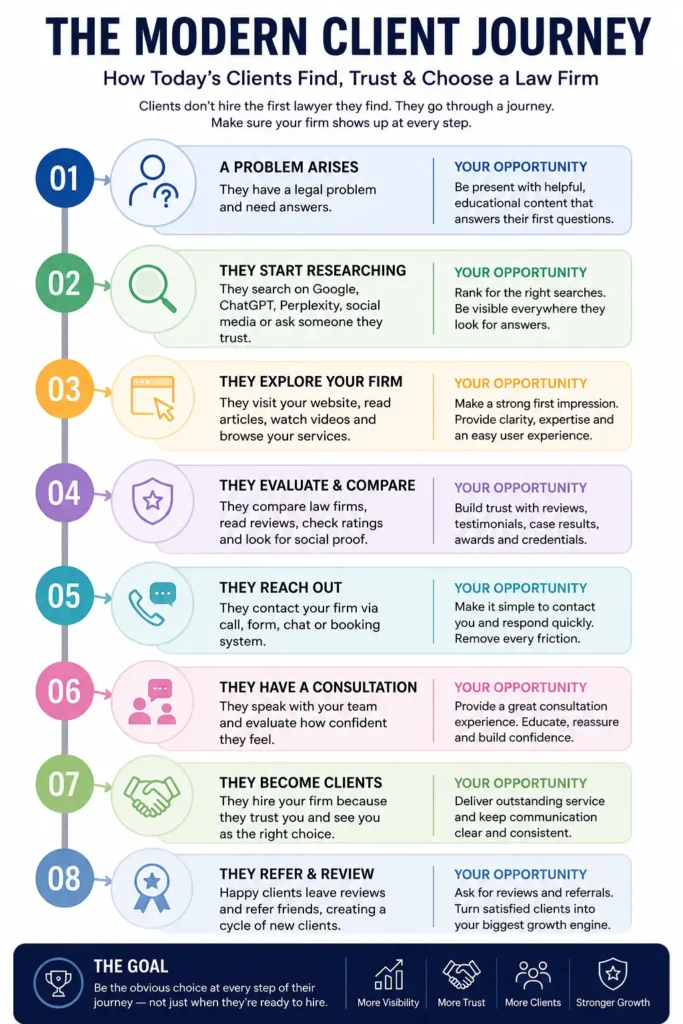
The Modern Client Journey Doesn’t Begin With “Hire a Lawyer”
This is where many legal marketing strategies fall apart.
Law firms often assume clients begin their search by looking for legal representation.
In reality, they begin with a problem.
Someone searches:
“What should I do after a car accident?”
Not:
“Best personal injury lawyer near me.”
Someone asks ChatGPT:
“Do I have a medical negligence claim?”
Not:
“Top medical negligence solicitor.”
Someone searches:
“How much compensation can I claim after a workplace injury?”
They’re looking for answers.
Not advertisements.
The law firm that helps them understand their situation earns something far more valuable than a click.
It earns trust.
By the time they’re ready to hire a lawyer, they’re naturally drawn back to the firm that already helped them.
That’s why educational content consistently outperforms promotional content over the long term.
Industry research from Clio’s Legal Trends Report shows that modern law firms increasingly rely on digital channels to attract and convert new clients.
Growth Doesn’t Come From One Marketing Channel
One thing I’ve noticed after working with service businesses is that firms often overestimate the importance of one channel.
Some believe SEO is the answer.
Others rely entirely on Google Ads.
Some focus only on referrals.
The fastest-growing firms rarely think that way.
Instead, they build a system where every channel strengthens another.
A blog answers a legal question.
That blog ranks on Google.
Someone visits your website.
They read client reviews.
Watch a short lawyer video.
Browse another article.
Then book a consultation.
None of those activities generated the client on their own.
Together, they created enough trust for someone to take the next step.
That’s what sustainable growth looks like.
Not one brilliant campaign.
Hundreds of small trust-building moments working together.
Introducing the G.R.O.W. Framework
Every successful law firm I’ve analysed does four things consistently.
Not occasionally.
Consistently.
That’s why I use what I call the G.R.O.W. Framework.
It isn’t another marketing tactic.
It’s a way of thinking about sustainable growth.
| Step | What It Means | Why It Matters |
|---|---|---|
| G – Get Discovered | Make your firm visible through Google, AI Search, local SEO and educational content. | People can’t hire a law firm they never find. |
| R – Reduce Uncertainty | Answer the questions clients ask before they contact you. | Trust starts before the first consultation. |
| O – Optimise Every Interaction | Improve your website, consultation process, reviews and calls-to-action. | More visitors become consultations. |
| W – Win Through Authority | Build a recognised brand through case studies, expert content, videos and client success stories. | Authority compounds over time and reduces reliance on paid advertising. |
Stop Measuring Marketing Channel by Channel
One of the reasons firms waste money is because they judge every marketing activity in isolation.
Someone asks:
“How many clients did LinkedIn generate?”
Someone else asks:
“Is SEO working?”
Then:
“Should we spend more on Google Ads?”
Those questions sound reasonable.
They’re also the wrong questions.
Clients don’t move through one marketing channel anymore.
They move through several.
A business owner might first see one of your LinkedIn posts.
Three weeks later they Google your firm.
The following weekend they read one of your articles.
A few days later they ask ChatGPT a legal question and your website appears again.
Before contacting you, they check your Google reviews.
Then they visit your website one final time before filling in the contact form.
So which channel generated the client?
The answer is all of them.
The goal isn’t to make SEO outperform social media.
Or make Google Ads outperform content marketing.
The goal is to make every channel reinforce the same message:
“This firm knows exactly what it’s talking about.”
That’s when marketing starts compounding.
The Firms Growing Fastest Have Fewer Gaps, Not Bigger Budgets
Imagine pouring water into a bucket with five holes.
You could pour in twice as much water.
Or you could fix the holes.
Most firms choose the first option.
They spend more on advertising.
The smarter investment is usually fixing the reasons people aren’t converting in the first place.
Here’s what those leaks often look like.
| Leak | What Happens |
|---|---|
| Weak service pages | Visitors don’t understand why they should choose your firm. |
| Few Google reviews | Potential clients don’t feel reassured. |
| No educational content | You never become part of the research process. |
| Slow website | Visitors leave before exploring further. |
| Generic messaging | Every law firm sounds exactly the same. |
| Poor follow-up | Qualified enquiries never become consultations. |
The Three Questions Every Potential Client Wants Answered
People rarely hire the first lawyer they find.
They hire the lawyer who gives them the most confidence.
Whether someone has been injured in a road accident or is searching for a family lawyer, they’re usually trying to answer three questions.
1. Can this firm actually help me?
This sounds obvious, but many websites make visitors work hard to find the answer.
Every service page should immediately explain:
- Who you help.
- What situations you handle.
- What happens next.
If someone has to guess whether they’re in the right place, they’ll keep searching.


2. Can I trust these people?
Trust isn’t built by saying:
“We’re experienced.”
Every law firm says that.
Trust is built through evidence.
Things like:
- Client reviews.
- Lawyer profiles.
- Helpful articles.
- Videos explaining legal topics.
- Awards.
- Media mentions.
- Case studies where appropriate.
Every one of those answers the same question.
“Can I trust this firm?”

3. What happens if I contact them?
This is one of the biggest conversion killers.
Many firms end every page with:
Contact us today.
But what actually happens?
Will someone call?
How soon?
Who will they speak to?
Is the consultation free?
How long does it take?
Removing uncertainty increases enquiries.
Sometimes dramatically.
Your Website Should Work Before Your Advertising Does
I often ask firms one simple question.
“If I switched off all of your advertising tomorrow, would your website still generate enquiries?”
Most firms go quiet.
That’s because the website has become a destination instead of a sales tool.
Think about what a great website should be doing every hour of every day.
It should:
- Answer legal questions.
- Build confidence.
- Show proof.
- Explain your process.
- Remove objections.
- Encourage consultations.
If your website isn’t doing those jobs, increasing traffic rarely solves the underlying problem.
One Great Article Can Outperform Thousands of Advertising Clicks
One of the biggest shifts in legal marketing over the last few years is how clients research legal services.
People don’t simply click an advert and hire a lawyer anymore.
They spend time learning.
Imagine someone searching:
“Should I accept the insurance company’s first settlement offer?”
Now imagine they find a genuinely useful article written by your firm.
It explains the risks.
It answers follow-up questions.
It links to related resources.
It introduces the lawyer who specialises in these cases.
Even if they don’t contact you that day, something important has happened.
You’ve become the firm they remember.
Months later, when they finally need representation, they’re far more likely to return to the lawyer who educated them than the lawyer whose advert they barely remember.
That’s why content isn’t just an SEO strategy.
It’s a trust strategy.
Don’t Try to Be Everywhere. Be Memorable Somewhere
Another mistake I see is firms trying to publish on every platform at once.
Facebook.
Instagram.
LinkedIn.
TikTok.
YouTube.
Newsletters.
Podcasts.
The result?
Average content everywhere.
Instead, ask yourself:
Where do our ideal clients actually spend time before hiring a lawyer?
If you’re a personal injury firm, Google should probably be your biggest priority.
If you’re targeting business owners, LinkedIn may deserve more attention.
If your lawyers explain complex legal issues exceptionally well on camera, YouTube could become one of your strongest long-term assets.
The goal isn’t to win every platform.
The goal is to become difficult to ignore on the platforms that matter most to your future clients.

Marketing Stops Feeling Expensive When It Starts Compounding
Advertising works while you’re paying for it.
Authority keeps working long after you’ve published it.
A detailed guide written today might generate enquiries next month.
A helpful video could still answer questions six months from now.
A five-star review continues building confidence every day it’s online.
That’s the difference between spending money on visibility and investing in assets that continue creating value.
The firms that grow consistently aren’t constantly searching for the next marketing tactic.
They’re quietly building a library of trust that becomes harder for competitors to catch every year.
If Your Marketing Stops Working the Moment You Stop Paying, You Don’t Own It
There’s nothing wrong with advertising.
Google Ads can be incredibly effective.
Meta Ads can generate consultations.
LinkedIn can introduce your firm to the right audience.
The problem begins when those channels become your only source of new business.
Imagine waking up tomorrow and pausing every advertising campaign.
Would your firm still receive enquiries next month?
If the answer is no, that’s the real issue.
The firms that continue growing year after year have built marketing assets that keep working whether they’re running ads or not.
Those assets include:
- A website that answers real legal questions.
- Educational content that ranks on Google.
- Lawyer profiles that build confidence.
- Google reviews that reassure hesitant clients.
- Case studies that demonstrate expertise.
- Videos that simplify complex legal issues.
None of those disappear when your ad budget changes.
That’s what makes them valuable.
Where Should Law Firms Invest Their Marketing Budget?
One of the most common questions I hear is:
“If I have a limited budget, where should I invest first?”
There’s no single answer because every firm starts from a different place.
But this comparison usually helps.
| Marketing Channel | Speed | Long-Term Value | Should Every Law Firm Invest? |
|---|---|---|---|
| Google Ads | ⭐⭐⭐⭐⭐ | ⭐⭐ | Yes, if immediate enquiries are needed |
| SEO | ⭐⭐ | ⭐⭐⭐⭐⭐ | Absolutely |
| Educational Content | ⭐⭐ | ⭐⭐⭐⭐⭐ | Yes |
| Google Business Profile | ⭐⭐⭐⭐ | ⭐⭐⭐⭐ | Essential for local firms |
| AI Search Optimisation | ⭐⭐ | ⭐⭐⭐⭐ | Increasingly important |
| Social Media | ⭐⭐⭐ | ⭐⭐⭐ | Yes, but with a clear strategy |
| Reputation Management | ⭐⭐⭐⭐ | ⭐⭐⭐⭐⭐ | Non-negotiable |
Notice something.
The channels with the highest long-term value aren’t always the fastest.
That’s why firms that only chase quick wins often find themselves in the same position every year—buying another round of advertising.
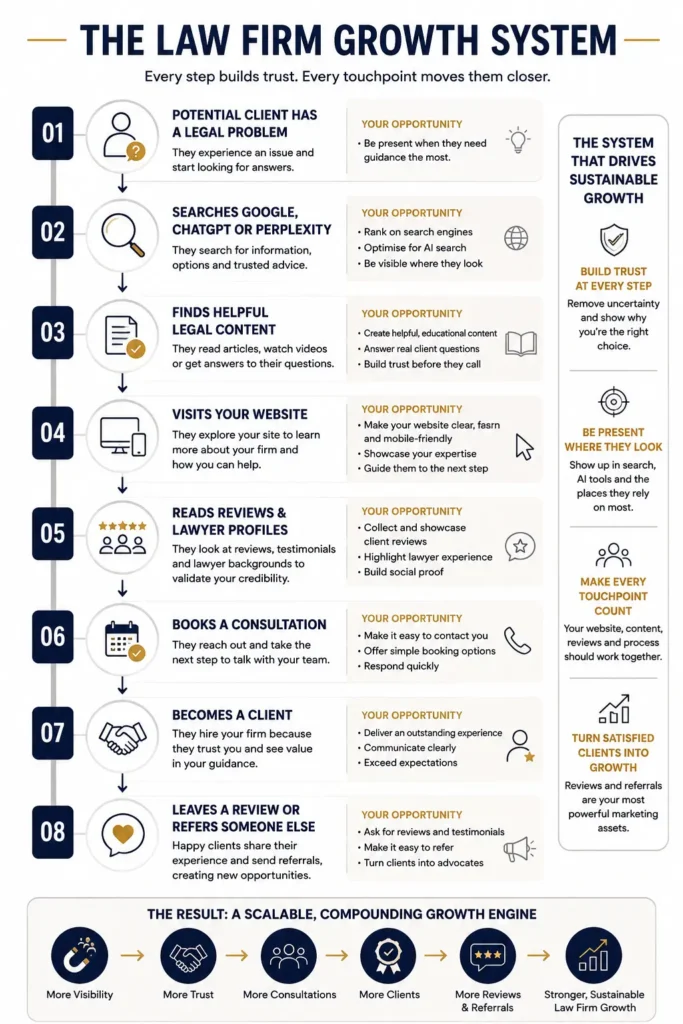
The Law Firm Growth System
Growth rarely happens because one campaign performs well.
It happens because every part of your marketing supports the next.
Potential Client Has a Legal Problem
│
▼
Searches Google, ChatGPT or Perplexity
│
▼
Finds Helpful Legal Content
│
▼
Visits Your Website
│
▼
Reads Reviews & Lawyer Profiles
│
▼
Books a Consultation
│
▼
Becomes a Client
│
▼
Leaves a Review or Refers Someone Else
This is why I encourage firms to stop asking:
“Which platform brings the most clients?”
Instead ask:
“Where can we remove uncertainty at each stage of this journey?”
That’s how you build a system instead of relying on isolated marketing tactics.
A Simple Audit Every Law Firm Should Complete
Before increasing your advertising budget, answer these questions honestly.
Visibility
- Can potential clients find you on Google for your key services?
- Is your Google Business Profile complete and regularly updated?
- Do you publish educational content around the legal questions clients actually ask?
Trust
- Do you have recent Google reviews?
- Does your website introduce the lawyers behind the firm?
- Are there examples of your expertise through articles, speaking engagements or case studies?
Conversion
- Is it obvious what happens after someone contacts your firm?
- Can visitors easily book a consultation?
- Does every service page include a clear call-to-action?
If you answered “no” more than three times, I’d fix those issues before increasing your advertising spend.
A Real Example
One firm approached me after spending heavily on paid advertising.
The enquiries weren’t terrible.
The consistency was.
Some months were excellent.
Others were painfully quiet.
Instead of recommending a larger ad budget, we looked at everything surrounding the advertising.
Their website answered very few client questions.
Practice area pages were thin.
There was almost no educational content.
Google reviews hadn’t been requested consistently.
Most importantly, there was no clear journey from someone discovering the firm to feeling confident enough to book a consultation.
Rather than chasing more clicks, we focused on building trust.
The result wasn’t just more enquiries.
It was a business that became less dependent on advertising because organic search, educational content and stronger conversion pages started doing more of the heavy lifting.
That’s exactly how sustainable growth should look.
Growing a law firm has never been about finding one marketing trick that nobody else knows.
It’s about building a business that clients trust before they ever pick up the phone.
The firms that continue growing aren’t constantly chasing the latest advertising tactic.
They’re investing in assets that become more valuable over time.
A better website.
Helpful content.
Stronger visibility.
Better reviews.
Clearer messaging.
Those things don’t just generate more enquiries.
They create a firm that’s easier to choose.
And that’s a competitive advantage no advertising campaign can buy.
Need a Marketing Strategy Built Around Growth—Not Just More Traffic?
Most agencies will tell you to increase your advertising budget.
I usually ask a different question:
“What happens if we improve everything around the advertising first?”
That’s exactly how I work with law firms growth.
Rather than treating SEO, content, AI Search, social media and conversion optimisation as separate services, I build marketing systems that help firms generate consistent, qualified enquiries.
Whether your goal is attracting more personal injury cases, improving your visibility on Google and ChatGPT, or turning more website visitors into consultations, the focus stays the same:
Build a law firm growth that clients discover, trust and choose—without relying entirely on paid advertising.
If you’d like a fresh set of eyes on your firm’s marketing, book a strategy call. I’ll show you where your biggest growth opportunities are and what I’d prioritise first.
Frequently Asked Questions
Can a law firm really grow without increasing its advertising budget?
Yes. Many firms increase enquiries by improving their website, strengthening SEO, publishing educational content, collecting more reviews and improving conversion rates before spending more on advertising.
Should I stop running Google Ads?
Not necessarily.
Google Ads are excellent for generating immediate enquiries.
The goal isn’t to replace them.
It’s to reduce your dependence on them by building organic visibility and stronger trust signals.
What’s the fastest way to improve law firm growth marketing?
Start with the pages that already receive traffic.
Improve the content, answer more client questions, strengthen your calls-to-action and make it easier for visitors to book a consultation.
Small improvements to high-traffic pages often produce bigger results than launching entirely new campaigns.
Do potential clients really research lawyers before making contact?
Almost always.
They compare firms, read reviews, visit websites, search Google, watch videos and increasingly use AI tools to understand their legal options before choosing who to contact.
Being visible throughout that journey gives your firm a significant advantage.
Does content marketing actually work for lawyers?
Yes—but only when it’s genuinely useful.
Articles that answer real legal questions often continue generating traffic and enquiries long after they’re published, making them one of the strongest long-term marketing assets a firm can build.
How long does it take to see results?
Paid advertising can generate enquiries within days.
SEO, educational content and authority-building typically take several months, but they continue delivering value long after the initial investment.
That’s why the strongest firms usually combine both short-term and long-term strategies.
What’s the biggest mistake law firms growth make with marketing?
Treating every marketing channel as a separate project.
Your website, SEO, reviews, content, Google Business Profile, AI Search and advertising should work together.
When they do, growth becomes much more predictable.