


25 September, 2026
Why High-Value Legal Services Can Have Poor Google Rankings
There isn’t usually one single reason.
In many cases, it’s a combination of how the website has been structured, what Google understands about the firm’s expertise and where previous SEO efforts have been concentrated.
Table of Contents
Toggle1. Your Law Firm Practice Area Pages Are Too Generic
This is one of the first things I’d look at.
A page titled:
Commercial Litigation
followed by 400 words explaining that your lawyers are “experienced, professional and committed to achieving the best possible outcome” doesn’t give search engines—or potential clients—much to work with.
Many law firm practice area pages say almost exactly the same thing.
Change the firm name and they could belong to another law firm.
A strong practice area page should make it clear:
- what matters the firm handles;
- who the service is for;
- what situations lead clients to seek help;
- where the firm provides the service;
- what related legal issues are involved;
- what questions prospective clients commonly have;
- why the firm’s experience is relevant.
That doesn’t mean writing 3,000 words because someone told you “long content ranks.”
It means making the page genuinely useful and specific.
2. Your Law Firm Keyword Strategy Is Focused on Volume Instead of Value
This is where SEO and business strategy need to talk to each other.
Suppose Keyword A receives thousands of searches.
Keyword B receives considerably fewer.
It can be tempting to build the strategy around Keyword A simply because an SEO tool shows the larger number.
But what if Keyword B describes exactly the kind of matter your firm wants?
The commercially valuable keyword isn’t necessarily the keyword with the highest search volume.
Your law firm keyword strategy should consider:
search demand + intent + service value + relevance + likelihood of conversion.
Otherwise, you can increase traffic while barely affecting the pipeline.

3. You’re Ranking for Legal Information, Not Legal Services
This distinction can completely change how you interpret SEO performance.
Consider searches such as:
“What is commercial litigation?”
versus:
“commercial litigation lawyer Dubai”
or:
“employment lawyer for business dispute near me.”
They’re not the same search.
The first may indicate someone researching a subject.
The latter searches indicate a much clearer need for a legal provider.
Educational content absolutely has a role in SEO for lawyers. It can build topical depth, answer important questions and introduce potential clients to your firm.
But blog traffic shouldn’t be mistaken for service visibility.
Look separately at:
Informational visibility
Are people finding your articles?
and
Commercial visibility
Are people finding your practice-area and service pages when they’re looking for legal help?
You need both.
4. One Legal Practice Area Has Become Much Stronger Than the Others
Sometimes the problem isn’t that the website has poor law firm SEO.
It’s that Google has much stronger signals around one particular subject.
For example, perhaps your firm has:
- several detailed family-law pages;
- years of articles answering family-law questions;
- lawyer bios demonstrating relevant experience;
- internal links pointing toward family-law services;
- external mentions associated with that area;
- strong engagement with those pages.
Meanwhile, your commercial-law section consists of one general page.
It shouldn’t be surprising if the website develops significantly stronger search visibility around family law.
If another practice area is strategically important, it may need its own content ecosystem.
5. Your High-Value Legal Service Is Buried in Your Website
Here’s a simple test.
Starting from your homepage, how easily can someone reach the service?
If an important practice area lives under:
Services → Business Services → Other Services → Specialist Services → Commercial Disputes
you’ve already made discovery unnecessarily difficult.
Website architecture matters to legal services SEO.
Your commercially important services should have clear places within the site’s structure, supported by relevant internal links.
That doesn’t mean putting 47 practice areas in the navigation.
It means creating a logical hierarchy that helps both people and search engines understand what’s important.

6. Your Law Firm Practice Area Pages Compete With Each Other
This can happen as law firm websites grow.
You might have:
/commercial-litigation/
/business-disputes/
/commercial-dispute-lawyers/
/business-litigation/
And several blog posts covering almost the same subject.
Now you have multiple URLs trying to establish relevance for closely related searches.
Instead of automatically creating another page every time you discover a keyword, first ask:
Does this query need its own page?
Sometimes it does.
Sometimes the better solution is strengthening an existing page.
A good law firm SEO strategy isn’t about producing the maximum number of URLs. It’s about giving each important search intent a clear destination.
7. Your Lawyer Profiles Aren’t Supporting Your Legal Services
Lawyer bios shouldn’t be an afterthought.
If someone is considering hiring a lawyer for a high-value or sensitive matter, they’re unlikely to care only about the firm’s logo.
They want to know:
Who would actually be handling this?
Relevant lawyer profiles can reinforce the wider content around a practice area by clearly communicating:
- areas of practice;
- professional experience;
- qualifications;
- jurisdictions;
- languages;
- publications;
- relevant professional memberships;
- representative experience where appropriate.
They also give prospective clients another layer of reassurance before making contact.

8. Your Content Strategy Isn’t Supporting Your Most Important Practice Areas
Open your firm’s last 20 articles.
What are they about?
This can be surprisingly revealing.
You might say commercial litigation is a strategic priority while almost every recent article covers general legal news, company announcements and unrelated topics.
Your content doesn’t need to become an endless collection of keyword articles.
But there should be a relationship between your content strategy and the legal services you want to grow.
If commercial litigation matters commercially, you could build useful content around the real questions surrounding commercial disputes.
Those articles can then naturally support the principal commercial-litigation page.
9. Local SEO for Your Law Firm Doesn’t Match Your Practice Area Strategy
Location introduces another layer.
A firm may perform strongly for its name and even rank locally for broad searches while having weak organic visibility for specific combinations of service + location.
This becomes particularly important for firms operating across several offices.
For example, having offices in three cities doesn’t automatically mean every practice area is equally visible in all three.
Before creating dozens of city pages, determine:
- which services are actually offered from each location;
- whether meaningful search demand exists;
- whether the firm has genuine relevance to that market;
- whether a dedicated page would provide something useful rather than duplicate another page.
Creating hundreds of near-identical location pages isn’t a substitute for a real law firm local SEO strategy.
10. You’re Measuring Law Firm SEO With the Wrong KPIs
This may be the biggest strategic issue.
Imagine this report:
Organic traffic: +40%
Looks excellent.
But then you discover:
Commercial litigation enquiries: unchanged.
That’s why I don’t think law firms should evaluate SEO solely through total organic traffic.
For high-value practice areas, I’d want to understand things such as:
- non-branded search visibility;
- rankings for commercially relevant queries;
- impressions for priority practice areas;
- organic landing-page performance;
- qualified enquiries;
- calls;
- consultation requests;
- conversion rates;
- which practice areas generated those enquiries.
Traffic is useful.
Commercially relevant visibility is better.
How to Find Which High-Value Legal Services Are Invisible on Google
You don’t need to guess.
Start by making a simple table.
| Practice area | Business priority | Google visibility | Organic enquiries | Action |
|---|---|---|---|---|
| Commercial litigation | High | Low | Low | Priority |
| Corporate law | High | Medium | Medium | Improve |
| Family law | Medium | High | High | Maintain |
| Employment law | High | Low | Low | Investigate |
The exact scoring system isn’t important.
The conversation it forces is.
Then investigate the priority areas using Google Search Console and your analytics/conversion data.
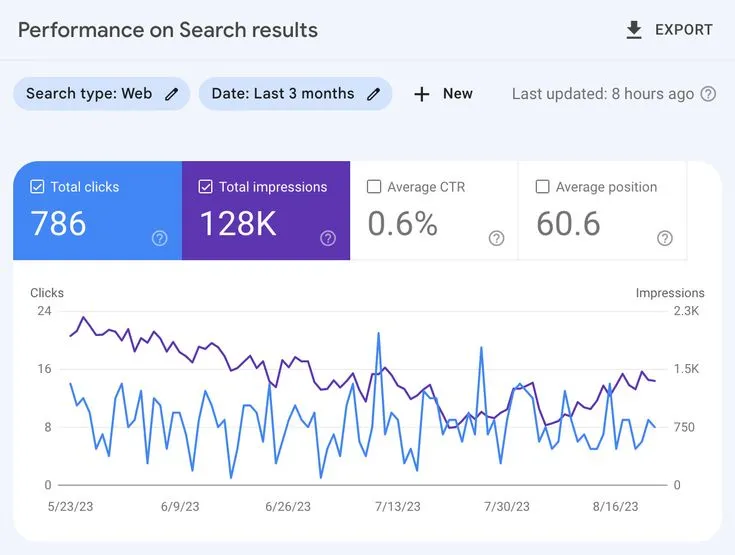
Use Google Search Console to Check Legal Service Visibility
For each important service page, look at:
Impressions
Is Google showing the page at all?
Queries
What searches trigger it?
Average position
Is the page sitting just outside meaningful visibility?
Clicks
Are impressions translating into visits?
Then compare that with actual enquiries.
You may discover a page has:
high impressions + poor rankings
which suggests a different problem from:
almost no impressions whatsoever.
That distinction affects what I’d investigate next.
How to Improve SEO for High-Value Legal Services
Don’t immediately start publishing more blogs.
Start with the commercial page itself.
Step 1: Decide Which Legal Services Actually Matter
Ask the business first.
Which practice areas:
- generate valuable matters?
- have capacity for growth?
- fit the firm’s expertise?
- have attractive economics?
- are strategically important?
SEO shouldn’t decide your business priorities.
Business priorities should inform your SEO priorities.
Step 2: Map Search Intent Around Each Practice Area
Determine how prospective clients search at different stages.
That could include:
Service searches
Commercial litigation lawyer
Problem searches
Business partner dispute lawyer
Location searches
Commercial litigation lawyer Dubai
Question searches
What happens when a business partner breaches a shareholder agreement?
Each type of query can play a different role.
Step 3: Strengthen the Main Practice Area Page
Make the primary commercial page the best destination for someone considering that service.
Improve its:
- positioning;
- relevance;
- structure;
- FAQs;
- lawyer connections;
- internal links;
- evidence;
- calls to action.
Step 4: Build Supporting Content Intentionally
Create content that answers genuine questions surrounding the practice area.
Then link those articles back to the relevant service page where appropriate.
You are building a connected subject area, not a pile of isolated blog posts.
Step 5: Strengthen Internal Linking
Relevant pages elsewhere on the site should help users discover the practice area.
For example:
Blog article → Commercial Litigation page
Lawyer profile → Commercial Litigation page
Related service → Commercial Litigation page
Case study/experience → relevant service
Internal links should be useful and contextual—not inserted simply because an SEO checklist says you need them.
Step 6: Measure Enquiries, Not Just Rankings
Finally, determine whether the additional visibility is producing business.
Because getting a practice area from position 18 to position 6 sounds great in a report.
But the question I’d eventually ask is:
Did it help the firm generate more of the right enquiries?
Your Law Firm Doesn’t Need to Rank for Everything
This is where I think law firms can waste a lot of SEO budget.
You don’t need maximum visibility for every service your lawyers could theoretically provide.
You need meaningful visibility around the areas that matter to the business.
I’d rather see a firm become genuinely competitive around five strategically important practice areas than have 60 thin service pages sitting somewhere in Google’s index.
The goal of law firm SEO shouldn’t simply be:
more rankings.
It should be:
greater visibility for the legal services the firm actually wants to grow.
And those aren’t always the same thing.

Is Your Law Firm Visible for the Services That Matter Most?
If your firm gets organic traffic but your highest-value practice areas still struggle to generate enquiries, the problem may not be “SEO” broadly.
It may be where your search visibility is concentrated.
That’s something worth diagnosing before spending more money producing content, increasing ad budgets or creating another batch of practice-area pages.
I help law firms look at SEO, content, paid search and digital strategy from the business side first — what you want to grow, where the gaps are, and what marketing should actually do about them.
FAQ:
Why is my law firm not ranking on Google?
A law firm’s Google visibility can be affected by many factors, including competition, website structure, content relevance, local search presence, authority, technical issues and how clearly individual practice areas are represented. Start by identifying whether the visibility problem affects the entire website or particular legal services.
How can law firms rank higher for specific legal services?
Start with a dedicated, useful practice-area page that accurately reflects the service, search intent and firm’s relevant expertise. Supporting content, internal linking, lawyer profiles, local relevance and wider website authority can then strengthen the subject area.
Should every legal service have its own page?
Not necessarily. A separate page makes sense when the service represents a distinct offering and search intent and there is enough useful information to justify the page. Creating numerous thin or overlapping pages can make the website harder to navigate and may create competing content.
What keywords should a law firm target?
Law firms should consider more than search volume when selecting keywords. Relevant service, location, client intent, business value and the firm’s actual practice should all inform the keyword strategy.
Does blogging help law firm SEO?
Useful legal content can support SEO by answering related questions and strengthening the site’s coverage of relevant subjects. However, publishing more articles alone doesn’t guarantee better rankings for commercial practice-area pages. Content should support a broader search and business strategy.
How do I know which legal services need SEO work?
Compare the firm’s strategic practice areas against their impressions, queries, rankings, organic landing-page traffic and enquiries. Google Search Console and analytics/conversion data can help identify services that matter commercially but receive little meaningful search visibility.