


7 August, 2026
Healthcare content marketing
Table of Contents
ToggleHealthcare content marketing
all about healthcare content marketing.
A patient sees your ad.
They click.
They visit your website.
And then they leave.
The ad worked. It reached the right person and generated the click.
So why didn’t the patient book?
Because getting someone’s attention and earning their trust are two different jobs.
This matters more in healthcare than in almost any other industry.
People rarely make healthcare decisions in seconds. They have questions. They worry about cost, treatment, recovery, risks and whether they are choosing the right provider.
An advertisement can introduce your clinic.
Educational content can give someone a reason to choose it.
That is why healthcare businesses should not measure marketing only by how many people they can reach. They should also consider what happens between the first interaction and the appointment.
This guide explains how healthcare content marketing can turn patient questions into search visibility, trust and ultimately more enquiries.
Advertising Captures Attention. Educational Content Builds Confidence.
Consider someone thinking about Invisalign.
An advertisement saying:
“Transform Your Smile With Invisalign — Book Today”
might get their attention.
But they may not be ready to book.
They may still want to know:
- Am I suitable for Invisalign?
- How long will treatment take?
- Is Invisalign painful?
- What does it cost?
- Invisalign or braces?
- Can adults get Invisalign?
- What happens during the first consultation?
Now imagine the same person finds an orthodontic clinic that has already answered every one of those questions.
They read an article comparing Invisalign and braces.
They watch the orthodontist explain treatment time.
They see a short video about what happens during the first consultation.
They read reviews from patients.
By the time they contact the clinic, much of the uncertainty has already disappeared.
That is the commercial value of patient education content.
It moves someone from:
“I have a question.”
to:
“I think this clinic can help me.”

What Is Healthcare Content Marketing?
Healthcare content marketing is the creation and distribution of useful information that helps patients understand their health concerns, treatments and options.
It can include:
- Blog articles
- Treatment guides
- Doctor-led videos
- FAQs
- Instagram Reels
- YouTube videos
- Email content
- Infographics
- Comparison pages
- Patient resources
- Social media posts
The purpose is not simply to publish more content.
Good healthcare content should do at least one of four things:
Answer a question.
Reduce uncertainty.
Demonstrate expertise.
Help someone make a better decision.
If your content does none of those things, publishing more of it probably won’t generate more patients.
Why Educational Content Generates Patient Enquiries
The relationship between content and patient acquisition is easier to understand when you look at what happens before someone books.
1. Patients Search for Answers Before They Search for a Clinic
Not every potential patient starts with:
“Orthodontist near me.”
Many start much earlier.
They search:
“Why are my gums bleeding?”
“How long does Invisalign take?”
“Is laser hair removal safe?”
“Why does my shoulder hurt when I sleep?”
“When should I see a dermatologist about acne?”
These searches are valuable because they reveal a problem before the patient has necessarily decided what to do about it.
Advertising tends to compete heavily at the bottom of the funnel:
“Dentist near me.”
Educational content lets you appear much earlier.
For example:
Problem: “Why do my gums bleed?”
↓
Article: Causes of Bleeding Gums and When to See a Dentist
↓
Patient learns about the problem
↓
Patient explores treatment
↓
Patient researches your clinic
↓
Patient books
Your content has now played a role in creating demand rather than simply competing for demand that already exists.
2. Healthcare Content Builds Trust Before the Consultation
Healthcare has a trust barrier.
If you’re buying shoes, making the wrong decision is annoying.
If you’re choosing a surgeon, dentist, therapist or specialist, making the wrong decision feels much more serious.
Patients want reassurance.
Educational content gives healthcare professionals an opportunity to demonstrate how they think before a patient meets them.
A dermatologist explaining when acne requires professional treatment is demonstrating expertise.
An orthodontist explaining the limitations of Invisalign is demonstrating honesty.
A physiotherapist explaining why some types of back pain require assessment is demonstrating knowledge.
The content doesn’t need to say:
“We are experts.”
The expertise should be obvious from the quality of the answer.
That’s far more convincing.
3. Educational Content Can Keep Working After You Stop Paying for It
This is one of the biggest differences between healthcare advertising and content marketing.
With paid advertising, visibility usually depends on continued spending.
You fund the campaign.
The ads run.
You stop funding it.
The traffic generally stops.
A useful article can have a much longer life.
Imagine publishing:
“Invisalign vs Braces: Which Is Better for Adults?”
That article could:
- Rank on Google.
- Be discovered through AI-powered search experiences.
- Be shared with patients.
- Become an Instagram carousel.
- Become a Reel.
- Become a YouTube video.
- Support your Invisalign treatment page.
- Be sent to prospects considering treatment.
One piece of expertise becomes several marketing assets.
That changes the economics of content.
You’re not paying repeatedly for every single interaction.
You’re building an asset your clinic owns.


4. Patient Education Improves the Quality of Enquiries
More leads are not always better.
A clinic can receive 100 enquiries and still have a poor month if most are:
- Looking for treatments you don’t provide.
- Outside your service area.
- Expecting unrealistic results.
- Not ready for treatment.
- Only asking for the cheapest price.
Educational content can qualify people before they contact you.
Suppose your clinic publishes a detailed guide explaining:
Who is suitable for Invisalign, how treatment works, typical timelines and what affects the cost.
Someone who reads it has much more context before submitting an enquiry.
Your content has already answered several questions your reception or clinical team would otherwise have to answer.
This can make the eventual conversation more productive.
5. Educational Content Gives Healthcare SEO Something Worth Ranking
You cannot build a strong healthcare SEO strategy around your homepage alone.
Patients search hundreds of questions related to:
- Symptoms
- Conditions
- Treatments
- Costs
- Recovery
- Risks
- Alternatives
- Specialists
- Locations
Every useful question creates a potential search opportunity.
For example, an orthodontic clinic could build content around:
Treatment pages
- Invisalign
- Ceramic braces
- Metal braces
Educational articles
- Invisalign vs braces
- How long does Invisalign take?
- Does Invisalign hurt?
- Can Invisalign fix an overbite?
- What can you eat with braces?
- How often are orthodontic appointments?
The treatment page captures people closer to booking.
The educational content captures people researching their options.
Together, they create a much stronger search presence.
6. Educational Content Gives Social Media a Business Purpose
A clinic posting:
“Happy Monday!”
is technically active on social media.
But what business problem did that post solve?
Compare it with an orthodontist publishing:
“3 signs your child may need an orthodontic assessment.”
Or a physiotherapist explaining:
“When back pain should not be ignored.”
Or a dermatologist answering:
“Does expensive skincare actually work better?”
Those posts have a reason to exist.
They answer questions.
They create conversations.
They give people something worth saving or sharing.
More importantly, they help potential patients become familiar with the people behind the clinic.
That familiarity matters when someone eventually needs treatment.
Healthcare Advertising vs Educational Content
Advertising and content should not be treated as enemies.
| Healthcare Advertising | Educational Content |
|---|---|
| Can generate visibility quickly | Usually builds visibility over time |
| Requires ongoing media spend | Can continue delivering value after publication |
| Strong for existing demand | Can capture earlier research |
| Promotes an offer or service | Answers patient questions |
| Excellent for testing demand | Excellent for building authority |
| Traffic can fall when campaigns stop | Strong content can remain discoverable |
| Useful for short-term acquisition | Useful for long-term acquisition |
| Gets attention | Builds understanding and trust |
The strongest healthcare marketing strategy often uses both.
Advertising creates speed.
Content creates depth.
Where Advertising Goes Wrong for Clinics
Advertising becomes expensive when it is expected to do the entire job.
Imagine a patient clicks an ad and lands on a treatment page.
The page contains:
- A short service description.
- No doctor information.
- No useful FAQs.
- No educational resources.
- No testimonials.
- No treatment explanation.
- No clear next step.
The clinic may blame the advertising campaign when conversion rates are poor.
But the real problem may exist after the click.
Paid advertising can bring someone to the door.
Your digital presence still has to convince them to walk through it.
That’s why I prefer looking at patient acquisition as a system rather than judging SEO, content, social media and advertising independently.
Read → How to Build a Predictable Patient Acquisition System

The Patient Education Funnel
Here’s a simple framework clinics can use.
Stage 1: Question
The patient has a problem.
“Why does my tooth hurt when I drink something cold?”
Stage 2: Education
They discover useful content explaining possible causes and when professional assessment may be appropriate.
Stage 3: Evaluation
They begin researching:
- Treatment options
- Providers
- Reviews
- Costs
- Credentials
- Location
Stage 4: Trust
They interact with your:
- Website
- Doctor profiles
- Videos
- Reviews
- Social content
- Treatment pages
Stage 5: Enquiry
The patient feels sufficiently informed and confident to contact the clinic.
Stage 6: Appointment
Your website, booking process and team convert the enquiry into an appointment.
Content does not replace this funnel.
Content helps people move through it.
What Healthcare Content Actually Generates Patients?
This is where many clinics waste time.
Publishing four generic blogs every month isn’t a strategy.
Start with questions connected to real patient decisions.
Treatment Questions
Examples:
- How does Invisalign work?
- What happens during a root canal?
- How long does physiotherapy take?
- What should I expect after laser treatment?
These help patients understand your services.
Comparison Content
Examples:
- Invisalign vs braces
- Physiotherapy vs chiropractic treatment
- Chemical peel vs laser treatment
Comparison searches often come from people actively evaluating options.
Cost Content
Many healthcare businesses avoid discussing price completely.
Patients don’t stop caring about cost because your website refuses to mention it.
You don’t necessarily need to publish a fixed price.
You can explain:
- What affects treatment cost.
- Why prices vary.
- What’s normally included.
- Financing or payment options, where relevant.
Transparency builds confidence.
“Am I Suitable?” Content
Examples:
- Am I too old for Invisalign?
- Who is suitable for dental implants?
- When should I see a physiotherapist?
- Is laser treatment suitable for sensitive skin?
These questions sit close to treatment consideration.
Myth-Busting Content
Healthcare is full of misinformation.
Clinicians are perfectly positioned to correct it.
But avoid creating sensational content just to generate engagement.
Accuracy matters more than virality.
Doctor-Led Content
This is particularly powerful.
Let the clinician answer the question.
Not the marketing manager.
Not generic stock footage with text over it.
The person patients may eventually trust with their care.
A 60-second explanation from a healthcare professional can often communicate more credibility than a polished promotional advertisement.

One Patient Question Can Become an Entire Content Campaign
You don’t need 30 new ideas every month.
Take one question:
“How long does Invisalign take?”
Turn it into:
Website article:
How Long Does Invisalign Take? Treatment Timeline Explained
Instagram Reel:
3 Things That Affect Your Invisalign Timeline
Carousel:
Your Invisalign Treatment Timeline
FAQ:
How long will I need to wear Invisalign?
Email:
What determines how long orthodontic treatment takes?
YouTube video:
Orthodontist Explains the Invisalign Timeline
Treatment page:
Add a concise timeline section.
One patient question.
Six useful assets.
That’s far more efficient than creating unrelated content for every channel.
Measure Content by Patient Behaviour, Not Page Views
A blog receiving 10,000 visits isn’t automatically valuable.
A treatment guide receiving 300 visits and contributing to 20 enquiries may be far more commercially important.
For healthcare content marketing, I would monitor:
- Organic impressions
- Relevant keyword visibility
- Engaged sessions
- Treatment-page visits
- Appointment-page visits
- Calls
- Form submissions
- WhatsApp enquiries
- Assisted conversions
- Returning visitors
- Branded searches
The question isn’t:
“How many people read our blog?”
It’s:
“Did this content help the right people move closer to becoming patients?”
Should Clinics Stop Advertising?
No.
That would be the wrong conclusion.
Paid advertising can be extremely effective for healthcare businesses, especially when:
- You need demand quickly.
- You’re launching a new location.
- You’re promoting a specific treatment.
- Organic visibility is still developing.
- You want to test a new market.
- Search demand is highly commercial.
The better strategy is to stop making advertising carry the entire patient acquisition burden.
For example:
Google Ads captures someone searching for treatment now.
SEO builds long-term search visibility.
Educational content answers their questions.
Social media creates familiarity.
Reviews provide reassurance.
Your website converts interest.
Retargeting brings some undecided visitors back.
Now you have a system.
Not an advertising dependency.

A Practical Healthcare Content Strategy for the Next 90 Days
If I were building content for a clinic from scratch, I wouldn’t begin by publishing every day.
I’d start with patient intent.
Month 1: Build the Foundation
Create or improve your core treatment pages.
Then identify the 10–20 questions patients ask most often about your highest-value treatments.
Publish three or four genuinely useful resources around those questions.
Month 2: Build Trust
Turn your strongest topics into clinician-led videos.
Add detailed FAQs to treatment pages.
Create comparison content.
Publish content that addresses common objections.
Month 3: Connect Content to Acquisition
Review which topics are generating search visibility and engagement.
Strengthen internal links.
Connect informational articles to relevant treatment pages.
Repurpose successful topics across social media.
Use high-performing content in paid campaigns and retargeting.
Then repeat based on data.
You don’t need hundreds of articles.
You need a library of content that helps patients make decisions.
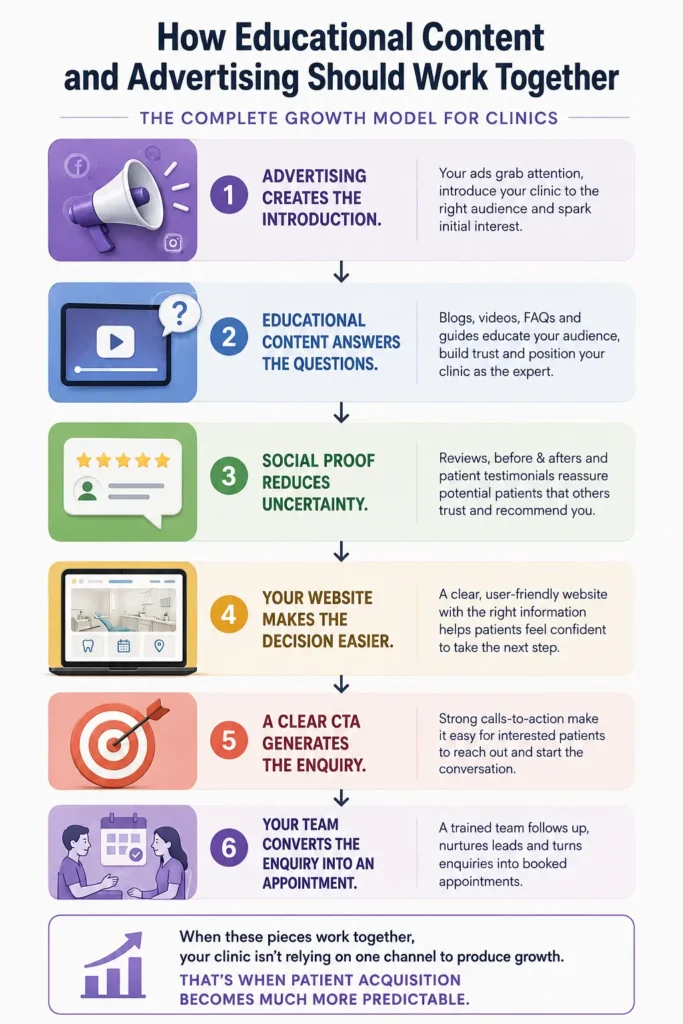
How Educational Content and Advertising Should Work Together
Here’s the model I recommend:
Advertising creates the introduction.
↓
Educational content answers the questions.
↓
Social proof reduces uncertainty.
↓
Your website makes the decision easier.
↓
A clear CTA generates the enquiry.
↓
Your team converts the enquiry into an appointment.
When these pieces work together, your clinic isn’t relying on one channel to produce growth.
That’s when patient acquisition becomes much more predictable.
Educational Content Is an Asset. Advertising Is Distribution.
This is the distinction I want healthcare businesses to remember.
Advertising buys access to attention.
Content gives you something valuable to do with that attention.
If you have excellent content but nobody discovers it, growth will be slow.
If you have excellent advertising but nothing useful or convincing behind the click, acquisition becomes expensive.
You need both distribution and substance.
But if I had to choose what creates the stronger long-term foundation, I would invest heavily in building a useful library of patient education.
Because every article, video, FAQ and guide adds another reason for patients—and search engines—to understand what your clinic knows.
Want More Patient Enquiries Without Depending Entirely on Advertising?
If your clinic is spending more every month just to maintain the same flow of enquiries, the answer may not be another advertising campaign.
You may need a stronger system behind the campaigns you already run.
I help healthcare businesses connect SEO, AI Search, patient education, social media, paid media and conversion strategy so each channel contributes to patient acquisition rather than operating on its own.
→ Explore our Healthcare Digital Marketing Services
Frequently Asked Questions About Healthcare Content Marketing
Does content marketing actually work for healthcare?
Yes, when content addresses real patient needs and connects to a wider acquisition strategy. Publishing generic articles simply to keep a blog active is unlikely to produce meaningful results.
How does educational content attract new patients?
Educational content can make your clinic visible while people research symptoms, treatments and providers. It also answers questions and builds confidence before someone makes an enquiry.
Is healthcare content marketing better than paid advertising?
They serve different purposes. Advertising can generate immediate visibility, while content can build search visibility and trust over a longer period. Strong healthcare strategies often use both.
How long does healthcare content marketing take to work?
There is no fixed timeline. Results depend on your website’s authority, competition, local market, content quality and distribution. SEO-led content usually requires patience, while existing audiences can respond to useful content much sooner.
What should healthcare clinics write about?
Start with the questions patients ask during phone calls and consultations. Treatment questions, costs, suitability, comparisons, recovery, risks and common misconceptions are often useful starting points.
How often should a healthcare clinic publish content?
Quality matters more than an arbitrary publishing frequency. One excellent resource that answers an important patient question can be more valuable than several thin articles published simply to meet a calendar.
Can healthcare content improve SEO?
Yes. Useful content can help a website become relevant for informational and treatment-related searches. It also creates opportunities for internal linking to treatment and service pages.
Should doctors create their own content?
Clinician involvement can significantly improve the credibility and usefulness of healthcare content. Marketing teams can handle research, structure and production while clinicians review or contribute the medical expertise.
Can Instagram content generate patients?
It can contribute to patient acquisition by increasing awareness, demonstrating expertise and building familiarity. The content still needs a clear route from education to enquiry.
How do you measure ROI from healthcare content?
Don’t rely only on traffic. Track enquiries, calls, appointment actions, assisted conversions, treatment-page journeys and other meaningful actions alongside search visibility.