


3 August, 2026
How to Build a Predictable Patient Acquisition System (That Doesn’t Depend on Luck)
Table of Contents
ToggleWhy Some Clinics Are Fully Booked While Others Rely on Hope Every Month
Predictable Patient Acquisition System:
Every clinic owner has experienced it.
One month, the appointment book is full.
The next month, things feel strangely quiet.
So you increase your Google Ads budget.
A few enquiries come in.
You breathe a sigh of relief.
A month later, you’re back where you started.
Then someone tells you to post more on Instagram.
Another marketer insists you need better SEO.
Someone else says it’s your website.
After a while, marketing starts feeling like you’re constantly chasing the next thing that might work.
The problem isn’t that these strategies don’t work.
The problem is that most clinics rely on individual marketing tactics instead of building a patient acquisition system.
There’s a big difference.
A campaign can generate enquiries.
A system generates them consistently.
The clinics that continue growing year after year aren’t constantly searching for new marketing ideas.
They’ve built a process that brings patients to them every single week.
Once you understand how that process works, marketing becomes far less stressful—and much more predictable.
That’s exactly what this guide will show you.
Patients Don’t Wake Up Wanting to Find a Clinic. They Wake Up Wanting an Answer.
This is one of the biggest mindset shifts clinic owners need to make.
Patients rarely begin their journey by searching for your clinic.
They begin with a problem.
Someone notices a lump.
Someone develops back pain.
Someone is worried about low testosterone.
Someone can’t sleep.
Their first search usually isn’t:
“Best clinic near me.”
It’s something like:
- Why does my shoulder hurt every morning?
- Is hair loss reversible?
- How do I know if I have low testosterone?
- Should I see a physiotherapist or wait?
At that moment, they aren’t looking for a clinic.
They’re looking for reassurance.
The clinic that earns their trust during this stage has already won half the battle.
That’s why educational content consistently outperforms promotional content in healthcare.
Patients don’t want another advertisement telling them you’re the best.
They want someone who understands what they’re going through.
The Real Competition Isn’t the Clinic Down the Road
Most clinic owners think they’re competing with the practice across the street.
They’re not.
Your biggest competition is uncertainty.
Patients delay appointments because they have unanswered questions.
They worry about the cost.
They’re unsure whether their symptoms are serious.
They’re afraid of wasting time.
They’re embarrassed.
Sometimes they simply don’t know who to trust.
Every unanswered question creates friction.
Every piece of helpful content removes it.
That’s why a predictable patient acquisition system isn’t built around advertising.
It’s built around reducing uncertainty at every stage of the patient’s journey.
Think Like a Patient for Five Minutes
Here’s a simple exercise.
Open your clinic’s website.
Pretend you’ve never seen it before.
Now answer these questions honestly.
Within the first few seconds…
- Do you immediately understand what this clinic specialises in?
- Is it obvious who the treatment is for?
- Would you feel comfortable trusting the doctor?
- Can you easily find pricing, FAQs or treatment information?
- Is booking an appointment effortless?
Most clinic owners judge their websites based on design.
Patients judge them based on confidence.
Those are two completely different things.
A beautiful website that leaves patients uncertain will almost always lose to a simpler website that answers every concern clearly.

Every Successful Clinic Has a System—Whether They Realise It or Not
When I audit healthcare businesses, I rarely find clinics that are genuinely short of opportunities.
What I usually find are disconnected marketing activities.
They run Google Ads.
Someone posts on Instagram when they have time.
The website hasn’t been updated in months.
Google reviews are collected occasionally.
A few blogs exist, but they don’t answer the questions patients are actually searching for.
Individually, none of these things are wrong.
The problem is that they don’t work together.
The busiest clinics don’t treat SEO, social media, websites and patient education as separate projects.
They’re all connected.
Each one supports the next.
That’s what creates consistency.
That’s what creates predictable growth.
The Framework We Use to Build a Predictable Patient Acquisition System
Over the years, one pattern has become impossible to ignore.
The clinics that consistently attract new patients don’t necessarily spend the most on marketing.
They simply make it easier for patients to discover them, trust them and take action.
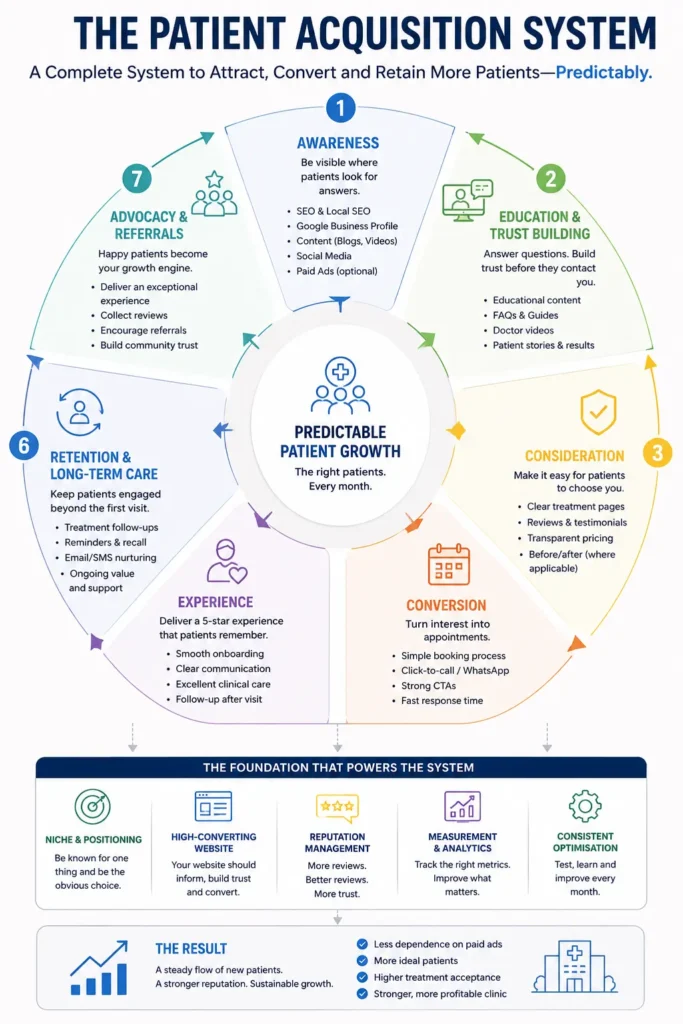
To do that consistently, every clinic needs to get seven things right.
That’s the framework we’ll walk through in the next section.
Not seven marketing tactics.
Seven parts of one complete patient acquisition system.
Because once those pieces start working together, you stop wondering where next month’s patients will come from—and start focusing on giving them a great experience when they arrive.
The Patient Acquisition System Starts Long Before Someone Books an Appointment
Ask most clinic owners where new patients come from and you’ll hear answers like:
“Google.”
“Word of mouth.”
“Facebook.”
“Referrals.”
Those aren’t sources.
They’re channels.
The real question is:
What convinced someone to choose your clinic instead of another one?
Because that answer is almost never:
“I saw your Google Ads.”
Patients don’t buy appointments.
They buy confidence.
Every interaction either increases or decreases that confidence.
Think about your own behaviour.
When you’re spending thousands on a holiday or buying a new car, you don’t make the decision after seeing one advert.
You research.
You compare.
You look for reassurance.
Healthcare decisions work exactly the same way—except the stakes are even higher.

The First Job Isn’t Getting More Traffic. It’s Becoming the Obvious Choice.
This is where many clinics waste money.
They assume:
More visitors = More patients.
It sounds logical.
It rarely works.
Imagine two dermatology clinics.
Clinic A gets 8,000 visitors every month.
Clinic B gets 3,000.
You’d probably assume Clinic A wins.
Now imagine Clinic A has:
- outdated treatment pages
- stock photos everywhere
- no doctor videos
- five Google reviews
- confusing navigation
- generic copy that could belong to any clinic
Clinic B has:
- educational videos from the doctors
- before-and-after examples (where appropriate and compliant)
- 300 genuine reviews
- detailed treatment guides
- clear pricing information
- an easy online booking process
Who gets more patients?
Most of the time…
Clinic B.
Because patients don’t compare websites.
They compare confidence.
Every page should answer one question:
“Would I feel comfortable putting my health in this clinic’s hands?”
If the answer isn’t obvious within a few minutes, they’ll keep searching.
Every Piece of Content Should Remove One Fear
One mistake I see repeatedly is clinics creating content around what they want to say.
Patients search differently.
Clinics write:
“Our clinic uses advanced technology.”
Patients search:
“Does laser treatment hurt?”
Clinics write:
“We’ve been serving patients for 20 years.”
Patients search:
“How long does recovery take?”
Clinics write:
“Our team is highly qualified.”
Patients search:
“Is this treatment permanent?”
Those are completely different conversations.
If your content doesn’t answer patient concerns, it won’t matter how often you publish.
The best-performing healthcare websites become libraries of reassurance.
Every article removes one concern.
Every video answers one uncomfortable question.
Every FAQ reduces hesitation.
By the time the patient contacts you, they’ve already decided they trust you.
Build Around Questions, Not Keywords
Most SEO strategies start with keyword research.
I think that’s backwards.
Start with conversations.
Sit with your reception team for one week.
Write down every question patients ask.
Not just the medical questions.
Everything.
Examples:
- How much does it cost?
- Do I need a referral?
- How soon can I get an appointment?
- Does insurance cover this?
- Will it hurt?
- How long will I be off work?
- What happens during the first consultation?
- What if the treatment doesn’t work?
Congratulations.
You now have months of content ideas.
Better still, you have content people are already looking for.
Google loves that.
Patients love that.
AI search platforms love that because they prioritise content that directly answers real-world questions.

Why Doctor-Led Content Wins Every Time
People don’t trust logos.
They trust people.
That’s why one honest three-minute video from a doctor explaining a common condition often outperforms an expensive promotional campaign.
Not because the production is better.
Because it feels genuine.
Think about the last healthcare video you watched.
Chances are you weren’t judging the lighting.
You were asking yourself:
“Does this person know what they’re talking about?”
That’s what patients want.
Authority doesn’t come from saying you’re an expert.
It comes from demonstrating it consistently.
One useful explanation today.
Another next week.
Another next month.
Eventually, patients begin recognising your clinic before they even need your services.
That’s where predictable growth begins.
Your Website Should Feel Like Your Best Receptionist
Receptionists answer questions all day.
Your website should do exactly the same thing.
Can someone understand:
- who you help?
- what conditions you treat?
- what the appointment involves?
- what happens afterwards?
- how to book?
…without needing to call?
If not, your reception team is solving problems your website should have solved already.
A high-converting healthcare website doesn’t simply look professional.
It reduces uncertainty.
It makes booking feel like the natural next step.

The Clinics Growing Fastest Don’t Think in Campaigns
Campaigns end.
Systems improve.
That’s a completely different mindset.
Instead of asking:
“What should we post this week?”
Ask:
“What stage of the patient journey are we improving this week?”
Maybe it’s awareness.
Maybe it’s trust.
Maybe it’s follow-up.
Maybe it’s reviews.
Every improvement strengthens the entire system.
Eventually, new patients don’t arrive because one post went viral.
They arrive because dozens of small improvements are working together every single day.
That’s what makes patient acquisition predictable.
Not luck.
Not algorithms.
A system that earns trust before a patient ever walks through your door.
Your Patient Acquisition System Is Only As Strong As Its Weakest Stage
Think of your clinic like a bucket.
Every marketing activity pours water into it.
Google Ads.
SEO.
Social media.
Referrals.
Email marketing.
Community events.
Doctor videos.
Now imagine there are holes in that bucket.
Patients can’t find your clinic on Google.
Your website loads slowly.
Treatment pages don’t answer basic questions.
You have very few Google reviews.
Booking an appointment feels frustrating.
It doesn’t matter how much money you pour into marketing.
The bucket will never fill.
That’s why clinics often believe they have a lead generation problem when they actually have a conversion problem.
Before spending another dollar on marketing, ask yourself:
Where is my bucket leaking?
Because fixing one leak is often more profitable than doubling your advertising budget.
The Metrics That Actually Matter
One mistake I see almost every clinic make is measuring the wrong things.
They celebrate:
✔ Website traffic
✔ Instagram followers
✔ Video views
✔ Facebook likes
Those numbers might feel good.
They don’t necessarily grow your clinic.
Instead, start tracking numbers that directly relate to patient acquisition.
For example:
Website
- How many visitors booked an appointment?
- Which treatment pages generate the most enquiries?
- Which pages have the highest exit rate?
- Where are people abandoning the booking process?
Search
- Which treatment-related keywords generate enquiries?
- How many patients find you through Google Business Profile?
- Which educational articles lead patients to book appointments?
Social Media
Forget viral videos.
Instead ask:
- How many profile visits became website visits?
- How many website visitors booked?
- Which videos generated genuine patient questions?
Those numbers tell you whether your marketing is building a business—not just an audience.
Don’t Build Your Marketing Around One Platform
Five years ago many clinics relied entirely on Facebook.
Then engagement dropped.
Others depended completely on Google Ads.
Competition increased.
Today some businesses are putting all their hope into AI search.
That’s just repeating the same mistake.
Algorithms change.
Platforms evolve.
Patient behaviour shifts.
The safest strategy has never been choosing the right platform.
It’s building authority everywhere your patients already spend time.
Google.
AI Search.
Google Maps.
Reviews.
YouTube.
Instagram.
Your website.
Email.
Each platform supports the others.
If one changes tomorrow, your Predictable patient acquisition system keeps working.
That’s what resilience looks like.


A Simple Exercise Every Clinic Should Do This Week
If you only take one action after reading this guide, make it this.
Open your website.
Pick one treatment page.
Then answer these questions honestly.
Does this page explain:
- Who the treatment is for?
- Common symptoms?
- Benefits?
- Risks?
- Recovery time?
- Frequently asked questions?
- What happens during the consultation?
- What patients should expect afterwards?
- Why they should trust your clinic?
- Exactly how to book?
If you answered “no” to several of those questions, you’ve just identified one of the reasons patients leave your website without contacting you.
The good news?
That’s fixable.
A Predictable Patient Acquisition System Doesn’t Happen Overnight
One article won’t transform your clinic.
One video won’t either.
Neither will one SEO campaign.
What creates predictable growth is consistency.
Publishing helpful content every month.
Improving one treatment page every week.
Collecting patient reviews regularly.
Making your booking process easier.
Listening to the questions your reception team hears every day.
None of those activities feel revolutionary on their own.
Together, they become difficult for competitors to copy.
That’s exactly why the busiest clinics usually stay busy.
They’ve spent years improving small things that eventually became a significant competitive advantage.
Marketing isn’t supposed to feel like gambling.
You shouldn’t have to wonder whether next month will be busy.
Or whether one algorithm update will suddenly slow your enquiries.
The clinics that continue growing year after year aren’t chasing every new marketing trend.
They’ve built a patient acquisition system that earns trust before a patient ever makes contact.
Once that system is in place, every new article, every review, every doctor video and every website improvement makes it stronger.
That’s what predictable growth looks like.
Need Help Building a Patient Acquisition System That Actually Works?
If your clinic is relying on referrals, inconsistent ad campaigns or marketing that feels disconnected, it’s probably time to step back and look at the bigger picture.
I work with healthcare businesses to build patient acquisition systems, not isolated campaigns.
That means combining:
- Healthcare SEO
- AI Search Optimisation (AEO)
- Content strategy
- High-converting healthcare websites
- Local SEO
- Google Business Profile optimisation
- Social media strategy that builds trust—not just reach
The goal isn’t simply to increase traffic.
It’s to help the right patients find your clinic, trust your expertise and confidently book an appointment.
If you’re ready to build a predictable patient acquisition system instead of relying on luck, let’s talk.
Frequently Asked Questions
How long does it take to build a predictable patient acquisition system?
If your clinic already has a website and some online visibility, you can often start seeing improvements within a few months. Building a system, however, isn’t a one-off project. It’s an ongoing process of improving visibility, trust and conversion. The goal isn’t a short-term spike in enquiries—it’s creating a reliable flow of new patients month after month.
Can a clinic rely on referrals alone?
Referrals are one of the strongest sources of new patients, but they aren’t predictable enough to build a long-term growth strategy around. A healthy clinic combines referrals with organic search, educational content, local SEO, reviews and a website that consistently converts visitors into appointments.
Is Google Ads enough to grow a clinic?
Google Ads can generate enquiries quickly, but they stop the moment you stop spending. A patient acquisition system combines paid advertising with SEO, content marketing and website optimisation so your clinic continues attracting patients even when ad spend changes.
What’s the biggest mistake clinics make with healthcare marketing?
Treating every marketing channel as a separate project.
SEO, social media, your website, reviews and educational content shouldn’t compete with each other. They should support each other. That’s what creates predictable growth.
What should I improve first if my clinic isn’t getting enough enquiries?
Start with the basics:
- Is your Google Business Profile fully optimised?
- Does your website clearly explain your treatments?
- Are you answering the questions patients actually search for?
- Is booking an appointment simple?
- Do you have recent, authentic patient reviews?
Fix those before increasing your marketing budget.
Do patients really use AI tools before choosing a clinic?
Increasingly, yes. Many people now use AI assistants to understand symptoms, compare treatments and research providers before booking an appointment. That makes clear, authoritative content even more important, because patients often form their first impression long before they visit your website.
How many blogs should a healthcare clinic publish?
Quality matters more than quantity. A clinic that publishes one genuinely useful article each month answering real patient questions will usually outperform a clinic publishing four generic posts written purely to target keywords.
What should every healthcare website include?
Every clinic website should clearly explain the treatments you offer, introduce your clinicians, answer common patient questions, include genuine reviews or testimonials where appropriate, make it easy to book an appointment and provide educational content that helps patients make informed decisions.