
21 August, 2026
Can ChatGPT Recommend Your Clinic? How AI Search Is Changing Patient Discovery
AI Search for Healthcare
A patient needs a dentist.
A dermatologist.
A physiotherapist.
A fertility clinic.
A cosmetic surgeon.
Until recently, we could make a fairly safe assumption about what happened next.
They went to Google.
That is still happening.
But now there is another possibility.
They open ChatGPT or another AI search tool and ask:
“Who are the best cosmetic dentists in Toronto?”
“Find me a good physiotherapy clinic near downtown Vancouver.”
“Which dental clinic in Calgary is good for implants?”
“What should I look for when choosing a fertility clinic?”
And instead of receiving ten blue links and doing all the research themselves, they may receive an answer that helps them narrow down their options.
ChatGPT Search can search the web for current information and provide answers with links to relevant sources.
That creates a new question for healthcare businesses:
Table of Contents
ToggleIf a patient asks AI for a clinic like yours, does your clinic make it into the conversation?
And if it doesn’t, why not?
AI Search Doesn’t Mean Google Is Dead
Let’s get this out of the way first.
Do not stop caring about Google.
Do not stop doing SEO.
And please don’t rebuild your entire marketing strategy because someone told you “SEO is dead because of ChatGPT.”
Patients still use traditional search.
They still use Google Maps.
They still read reviews.
They still visit clinic websites.
They still compare doctors.
They still look at treatment pages.
What’s changing is that search is becoming less linear.
A patient could discover a treatment on Instagram, ask ChatGPT about it, search Google for local providers, read reviews, visit two clinic websites and return to AI with another question.
The channels aren’t necessarily replacing one another.
They’re becoming part of the same decision.
That means your clinic needs to think beyond:
“Are we ranking on Google?”
The better question is:
“Can patients and search systems clearly understand why our clinic is relevant?”
What Happens When Someone Asks ChatGPT for a Clinic?
This is where things get interesting.
Traditional Google search might give someone a list of results to investigate.
AI search can help with some of that investigation.
ChatGPT Search, for example, can access current information from the web and provide links to sources used in its answers.
So a patient can ask a much more natural question.
Instead of:
dentist Toronto
they might ask:
“I’m looking for a cosmetic dentist in Toronto who offers veneers and has good patient reviews. Who should I look at?”
That’s a very different search.
There is more context.
More intent.
More detail.
And potentially fewer businesses presented in the answer.
If you’re one of ten organic Google results, you have a chance to win the click.
If an AI answer discusses only a handful of options and your clinic isn’t one of them, you may never enter that patient’s consideration set.
That’s why AI search visibility for healthcare deserves attention now.
Not panic.
Attention.
Can You Pay ChatGPT to Recommend Your Clinic?
This is where healthcare businesses need to be careful with anyone selling “ChatGPT ranking packages.”
There isn’t a magic button where I can submit your clinic and guarantee:
“ChatGPT will now recommend Dr Smith as the #1 dentist in Toronto.”
AI-generated answers can vary based on the question, available information, context, location and sources available to the system.
ChatGPT itself can also make mistakes, which is why OpenAI advises users to verify important information and review sources when accuracy matters.
So I wouldn’t promise a healthcare client:
“We will get you ranked #1 on ChatGPT.”
I would work on something more defensible:
Making the clinic easier to discover, understand and verify across search and the wider web.
That distinction matters.
So What Could Influence Whether Your Clinic Gets Discovered?
There isn’t one “ChatGPT ranking factor” checklist that guarantees recommendations.
But there are several things healthcare businesses should be thinking about.
1. Is It Obvious What Your Clinic Actually Does?
This sounds embarrassingly simple.
It often isn’t.
I still see healthcare websites where the homepage says things like:
“Helping you become the best version of yourself.”
Lovely.
But what do you actually do?
Where are you?
Who do you treat?
What services do you provide?
Who provides them?
Your website should make those answers painfully clear.
If you’re a dental clinic in Toronto offering dental implants, cosmetic dentistry and Invisalign, that information should be easy to identify.
Not hidden behind clever branding language.
2. Do Your Important Treatments Have Proper Pages?
Imagine you’re a dental clinic offering:
Dental implants.
Veneers.
Invisalign.
General dentistry.
Cosmetic dentistry.
And all five services are briefly mentioned on one page.
Now compare that with a competitor that has:
Dental Implants in Toronto
Porcelain Veneers
Invisalign Treatment
Cosmetic Dentistry
with detailed information about each service.
Which business has created clearer information about what it actually provides?
This matters for traditional SEO.
And the same clarity becomes useful in an AI-search environment.
Don’t create hundreds of thin pages simply to manipulate search.
Create genuinely useful pages around services patients need to understand.

3. Is Your Location Clear?
Healthcare is often local.
A clinic being excellent doesn’t help a patient much if they don’t know whether it’s 10 minutes or three hours away.
Your website should consistently communicate:
Clinic name
Address
City/service area
Contact details
Opening information
Services
Practitioners
For multi-location healthcare businesses, this becomes even more important.
Each location needs enough clarity that someone — or a search system — can understand what is available there.
4. Can Your Practitioners Be Understood as Real Experts?
Your doctor profile shouldn’t be an afterthought.
Patients want to know:
Who is treating me?
What are they qualified in?
What do they specialise in?
How much experience do they have?
Are they registered appropriately?
What professional organisations are they associated with?
And if your entire doctor bio is:
Dr Jane is passionate about helping patients achieve their dream smile.
you’ve told me almost nothing.
Good practitioner pages should clearly communicate genuine qualifications, experience, areas of practice and professional background without exaggerating credentials.

5. What Does the Rest of the Web Say About You?
Your website is only one source of information about your clinic.
There may also be:
Google Business Profile information.
Reviews.
Professional directories.
Healthcare directories.
Association profiles.
Media coverage.
Social profiles.
Local citations.
Articles.
Interviews.
Other websites mentioning your clinic or practitioners.
This is why I wouldn’t approach AI visibility as:
“Let’s add the word ChatGPT to our SEO package.”
The wider digital footprint matters.
Your clinic should exist as a clear, consistent and credible entity beyond its own website.
Reviews Become Even More Interesting
Think about how patients already choose healthcare providers.
A clinic tells you:
“We provide exceptional patient care.”
Of course it does.
Every clinic says that.
Patients look for outside evidence.
Reviews are one part of that evidence.
But don’t turn this into:
“Get 500 reviews and ChatGPT will rank you.”
That’s not a claim I’d make.
Instead, think about reviews as part of your clinic’s wider reputation.
They help prospective patients understand what other people experienced.
They can reinforce trust around a business.
And they can influence decisions regardless of whether the patient originally discovered you through Google, AI, social media or a referral.
Your Content Needs to Answer Better Questions
This is probably where healthcare content strategy needs the biggest rethink.
For years, SEO content became obsessed with keywords.
Someone sees:
“How much do dental implants cost?”
So they write:
How Much Do Dental Implants Cost? — 2,500 words
Then another clinic writes the same thing.
Then another.
Soon Google has hundreds of nearly identical articles.
AI makes generic information even easier to obtain.
That means clinics need to ask:
What can we add that is actually useful?
Your clinicians already have that information.
They answer patient questions every day.
What do patients misunderstand?
What makes someone unsuitable for a treatment?
Why can pricing vary?
What happens during recovery?
What concerns do patients repeatedly have?
What alternatives should someone consider?
What does your doctor wish patients understood before their first consultation?
That is much more interesting than publishing another generic article because an SEO tool gave you a keyword.
AI Search Makes Brand Authority More Important, Not Less
There is another behaviour worth thinking about.
A patient might first discover your clinic through AI.
But they’re unlikely to hand over their health decisions blindly because a chatbot mentioned your name.
They’re going to investigate.
They may Google you.
Read your reviews.
Visit your website.
Look at your doctors.
Check your social media.
Read treatment information.
Compare you with another clinic.
This is why I don’t think AI Search optimisation should exist in a little box separate from everything else.
It connects to:
SEO
local search
content
digital PR
reputation
website quality
practitioner authority
brand
and ultimately conversion.
The objective isn’t simply:
“Get mentioned by ChatGPT.”
The objective is:
Be discoverable, credible and easy to choose wherever the patient’s research begins.

What Should Your Clinic Do Now?
I wouldn’t recommend throwing away your current marketing plan and spending everything on “AI SEO.”
Start with the fundamentals.
Search for your clinic.
Search for your doctors.
Search for your priority treatments.
Look at your Google Business Profile.
Look at your treatment pages.
Look at your reviews.
Look at what other websites say about you.
Then try AI search yourself.
Ask questions a real patient might ask.
Not:
“Tell me about ABC Dental Clinic.”
That’s a branded search.
Try:
“Which clinics offer dental implants in [city]?”
“What are some well-reviewed cosmetic dentists in [city]?”
“Where can I get Invisalign in [area]?”
“Which clinics specialise in [treatment] near me?”
Then look at what happens.
Does your clinic appear?
Which competitors appear?
What sources are being referenced?
What information seems easier to find about them than about you?
You aren’t looking for a magical AI score.
You’re looking for gaps.
Don’t Forget What Happens After Discovery
Suppose we succeed.
Someone asks an AI tool for a clinic.
Your clinic appears.
They click through.
And your website takes eight seconds to load.
The treatment page says almost nothing.
Your doctor’s profile is two sentences.
There’s no clear pricing guidance where appropriate.
The booking button is buried.
The mobile experience is awful.
Nobody answers the enquiry until two days later.
AI visibility didn’t solve your patient acquisition problem.
Discovery is only the beginning.
The complete journey still matters:
Discovery → trust → consideration → enquiry → booking → patient
That’s why I wouldn’t measure AI Search success purely by whether your clinic gets mentioned.
I’d want to know whether this new visibility eventually contributes to real patient opportunities.
Also check out our blog on how long SEO takes for healthcare clinics
Will AI Search Replace Healthcare SEO?
I don’t think that’s the useful question.
Search behaviour is changing, and businesses should respond to that change.
ChatGPT Search can already retrieve current information from the web and connect users to original sources.
That creates another discovery environment healthcare businesses need to understand.
But the work required to build a strong digital presence hasn’t suddenly disappeared.
If anything, clinics now have more places where their digital reputation can influence a patient’s decision.
Google.
Maps.
AI Search.
Reviews.
Your website.
Your doctors.
Social media.
Third-party sources.
They are becoming parts of the same research journey.

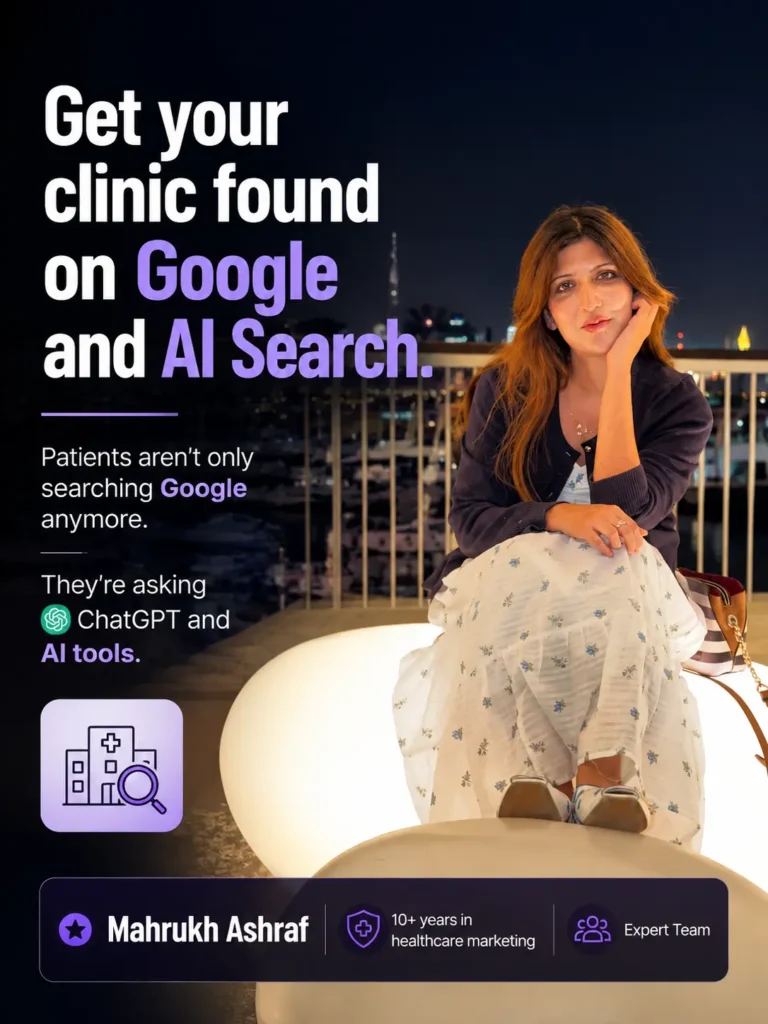
The Clinics That Adapt Early Won’t Just “Optimise for ChatGPT”
They’ll do something much more useful.
They’ll make their digital presence easier to understand.
They’ll clearly communicate what they do.
They’ll build stronger treatment pages.
They’ll make practitioner expertise visible.
They’ll answer real patient questions.
They’ll strengthen their local presence.
They’ll build genuine authority beyond their own website.
They’ll monitor how their brand appears across traditional and AI search.
And they’ll make sure that when a patient finally lands on the website, there is a reason to choose them.
Because the real opportunity isn’t:
“How do I trick ChatGPT into recommending my clinic?”
It’s:
“How do I make my clinic one of the most credible and relevant answers when someone is looking for the care we provide?”
That’s a much better marketing question.
Want to Know How Visible Your Clinic Is Across Google and AI Search?
My team and I help healthcare businesses connect SEO, AI Search visibility, paid media, content and conversion around one objective:
getting discovered by the right patients and turning that visibility into real enquiries.
If you’re investing in marketing but aren’t sure how your clinic is positioned for the next generation of search, let’s look at it.