
4 November, 2026
How to Check Whether ChatGPT Recommends Your Business (Free Tracking Template)
Your business might rank on Google, have great reviews and still be missing from the recommendations people receive through ChatGPT. Here’s how to find out—and what to do with the results.
Imagine someone asks ChatGPT:
“Can you recommend three good physiotherapy clinics in Toronto for sports injury recovery?”
Three businesses appear.
Yours isn’t one of them.
Now imagine a different customer asks:
“Which physiotherapy clinics in Toronto offer evening appointments?”
This time, your business appears—but the answer gets your opening hours wrong.
Which situation is worse?
The first suggests a potential discovery problem. The second suggests an accuracy problem. Both matter, but they require different responses.
That’s why checking whether ChatGPT recommends your business isn’t as simple as asking it your company name once.
You need to understand when your business appears, what ChatGPT says about it, which sources support the answer and how consistently it appears across relevant customer questions.
This guide walks you through a practical AI visibility audit you can conduct yourself, including a free tracking template.
Table of Contents
ToggleFirst, what does it actually mean to be recommended by ChatGPT?
There are three different outcomes business owners often confuse.
1. ChatGPT knows your business exists.
You ask, “What does ABC Dental Clinic do?” and receive a description.
That’s useful, but you supplied the business name. It doesn’t tell you whether ChatGPT would have discovered or suggested the clinic independently.
2. ChatGPT mentions your business when someone asks for recommendations.
A potential customer asks for dental clinics offering a particular treatment in their city, without naming your practice.
Your clinic appears among the suggestions.
This is a more meaningful discovery signal because the business was not supplied in the question.
3. ChatGPT cites your website as a source.
Your website appears as a supporting link in an answer.
That’s valuable visibility, but being cited isn’t the same as being recommended. ChatGPT might cite an educational article from your website while recommending entirely different providers.
For a business owner, the most useful audit separates all three.
Step 1: Test the questions your customers would actually ask
The biggest mistake I see in AI visibility testing is using prompts that sound like they were written by an SEO tool.
Real customers don’t necessarily ask:
“List the top ten providers optimized for AI search in my geographic market.”
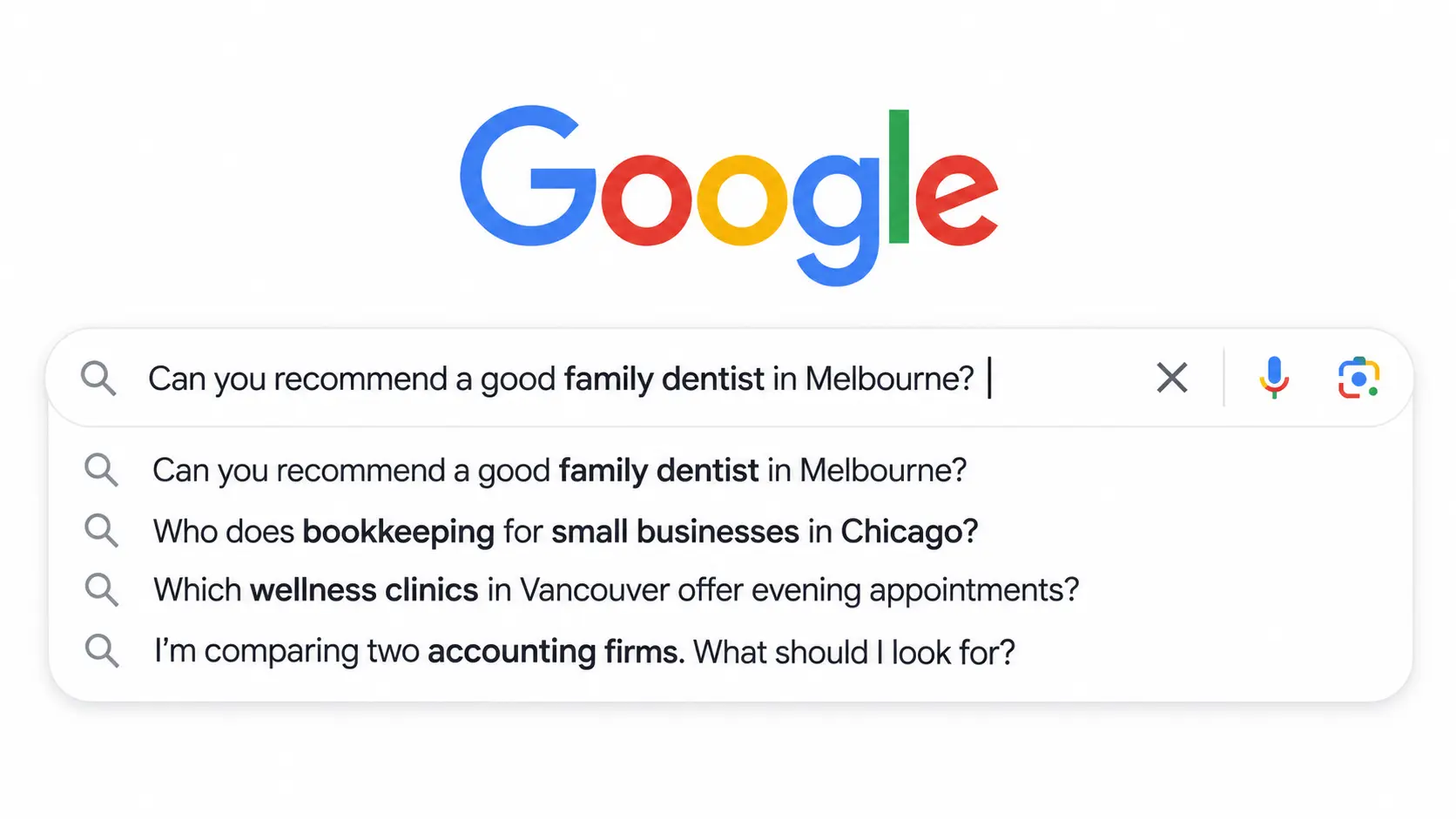
They ask things like:
“Can you recommend a good family dentist in Melbourne?”
“Who does bookkeeping for small businesses in Chicago?”
“Which wellness clinics in Vancouver offer evening appointments?”
“I’m comparing two accounting firms. What should I look for?”
Start by thinking about the moment before someone chooses a business.
What problem are they trying to solve? What do they care about? What would make them choose one provider over another?
Build your first prompt list
For a useful starting audit, create prompts across five categories.
| Prompt category | Example |
|---|---|
| General discovery | Recommend three independent accounting firms in Austin for small businesses. |
| Specific service | Which accounting firms in Austin help businesses with payroll and bookkeeping? |
| Customer constraint | Find accounting firms in Austin that offer virtual consultations. |
| Decision support | What should I look for when choosing an accountant for my small business in Austin? |
| Direct comparison | Compare ABC Accounting with XYZ Accounting for a small business owner. |
The first four can reveal whether your business appears without being named. The fifth helps you understand how ChatGPT describes your business when it is explicitly included.
My recommendation: Start with 8–12 questions based on genuine customer needs. Don’t create 100 near-identical prompts simply to produce a bigger spreadsheet.
If your customers frequently ask your sales team the same questions, those are excellent candidates for testing.
Step 2: Run the tests without accidentally influencing the answers
This part is more important than it sounds.
Suppose you regularly use ChatGPT to discuss your business, its services and competitors. If you then ask it to recommend providers in your industry, your existing conversation context may influence the response.
You could mistakenly interpret a personalized answer as evidence of broader visibility.
For a cleaner audit:
Start a fresh conversation for each test.
Where possible, use a testing setup without previous business-related conversation history or personalization.
Use ChatGPT’s search capability for queries where current business information matters.
Keep the geographic context consistent.
Record the exact question rather than rewriting it from memory.
Repeat the same questions across multiple sessions.
ChatGPT Search can use location context, and previous information may affect how searches are interpreted. OpenAI also notes that search citations can be incomplete or inaccurate, so they should be checked against their sources.
A fresh chat is a useful starting point, but it doesn’t necessarily eliminate account-level personalization. For a more controlled test, use a suitably configured account or environment with personalization disabled.
Why location matters
Consider these questions:
“Recommend a good accountant.”
“Recommend a good accountant in Sydney.”
“Recommend an accountant in Sydney who works with independent restaurants.”
Those are three different requests.
The third is especially valuable because it represents a customer with a specific buying need.
For local businesses, record the city or market being tested. If you serve multiple locations, audit them separately.
And don’t assume that a result from Toronto tells you how your business will appear to someone searching from Vancouver.
Step 3: Record more than whether your name appears
Imagine your business appears in seven out of ten test responses.
That sounds encouraging.
But what if five of those mentions describe your services incorrectly?
Or what if ChatGPT repeatedly recommends you for services you no longer offer?
A useful AI visibility audit needs to measure both visibility and accuracy.
Here’s what I would record for every test.
| What to track | Why it matters |
|---|---|
| Exact prompt | Makes future comparisons possible |
| Date and market | Establishes when and where the test happened |
| Platform and search mode | Helps you compare like with like |
| Business mentioned? | Measures visibility in the tested responses |
| Position in the response | Shows where the business appeared, if a list was given |
| Website cited? | Distinguishes a citation from a recommendation |
| Other businesses mentioned | Identifies competitors appearing in the same context |
| Accuracy | Reveals incorrect or outdated information |
| Source links | Helps identify where information may be coming from |
| Screenshot | Preserves evidence for later comparison |
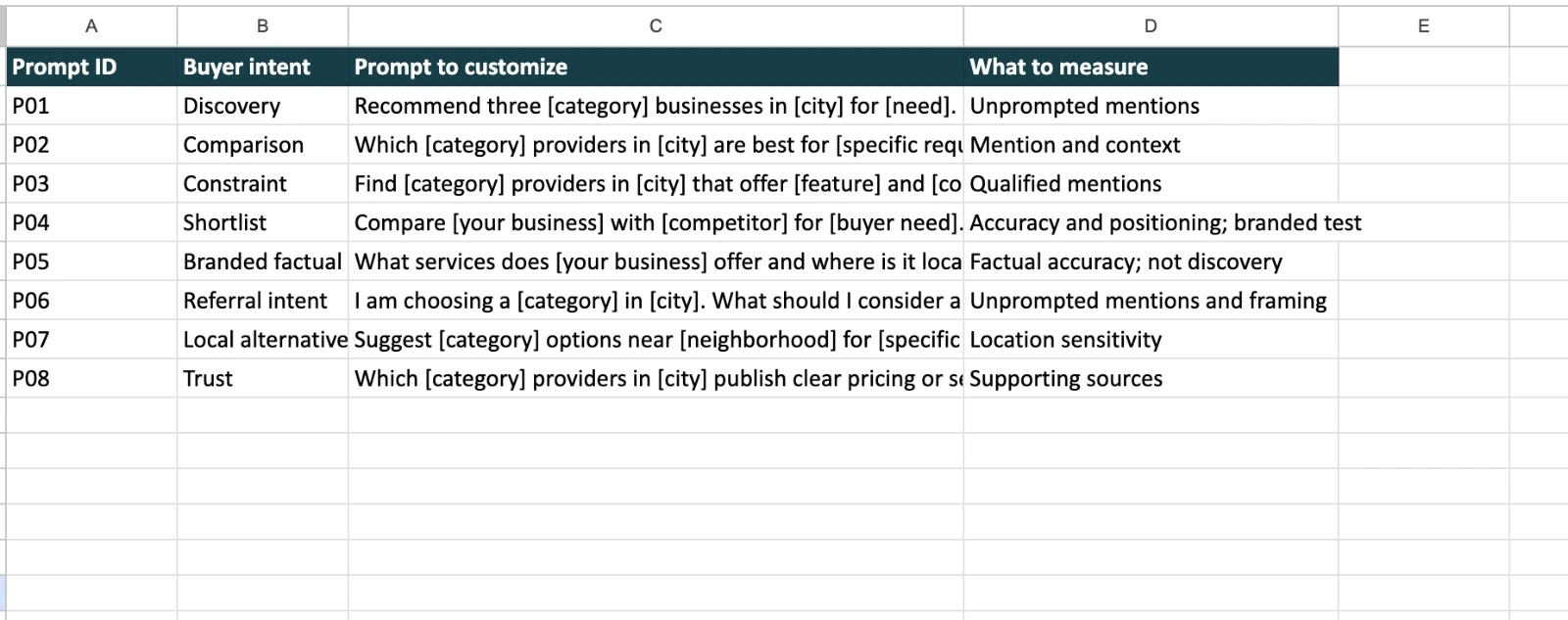
I created a free spreadsheet that includes these fields, a reusable prompt library and a basic summary dashboard.
Download the free AI recommendation tracking template: AI Recommendation Tracking Template
The workbook includes illustrative examples. Delete those before recording your own audit.
Step 4: Calculate your AI recommendation rate
Once you’ve completed your first round of testing, calculate how often your business was mentioned.
Recommendation mention rate = (Number of eligible responses mentioning your business ÷ Total eligible responses tested) × 100
For example, suppose you run 20 relevant discovery prompts and your business appears in 6 responses.
Your observed mention rate would be:
6 ÷ 20 × 100 = 30%
That does not mean ChatGPT recommends your business to 30% of all users.
It means your business appeared in 30% of the specific responses you tested, under your testing conditions.
That distinction matters.
AI answers can vary by wording, context, available information and other factors. A small audit provides a directional baseline, not a statistically representative measurement of every possible recommendation.
For a more useful comparison, keep the prompt set consistent and run multiple repetitions.
Separate branded and unbranded results
I would never combine these into one headline metric.
If ChatGPT mentions your business because you asked about it by name, that shouldn’t count toward your unprompted discovery rate.
Track at least two separate measures:
Unprompted mention rate: How often the business appears when the question doesn’t include its name.
Branded answer accuracy: How accurately ChatGPT describes the business when asked about it directly.
Also track website citations separately.
This prevents an inflated visibility score from creating false confidence.
Step 5: Check what ChatGPT is saying about your business
Getting mentioned is only half the story.
Let’s say ChatGPT recommends your wellness clinic but says you provide nutritional consultations, when you actually specialize in physiotherapy.
That recommendation could attract the wrong customers or create confusion.
During your audit, check:
Services: Are the services accurate and current?
Location: Is the address correct? Does the answer imply you operate in places you don’t serve?
Positioning: Does ChatGPT describe what makes your business different, or does it give a generic description that could apply to anyone?
Pricing: Does it quote prices you haven’t published or that are outdated?
Reputation: Are claims about ratings, qualifications or awards supported by reliable information?
Website links: Do cited links work, and do they actually support the claims being made?
For regulated industries such as healthcare and legal services, accuracy deserves particular attention.
A misleading statement about a professional’s qualifications, specialty or services is more consequential than a slightly outdated product description.
Follow the sources
When ChatGPT provides citations, open them.
Ask yourself:
Is the information coming from my website?
Is it coming from a third-party directory?
Is the page current?
Does it actually support the statement?
Is an outdated profile contradicting my current website?
Don’t assume a citation proves exactly how the answer was generated. It tells you which supporting sources are displayed, not the complete internal process behind the response.
Still, source inspection can reveal practical issues you can fix.
Step 6: Compare your business with the competitors ChatGPT mentions
This is where the audit becomes more useful as a marketing exercise.
Suppose you run 15 prompts about dental clinics in your city.
Your clinic appears twice.
A competitor appears in nine responses.
The tempting conclusion is:
“They’ve figured out how to rank in ChatGPT.”
Maybe. But you don’t have enough evidence to say that.
Instead, investigate the differences.
Does the competitor have dedicated pages explaining each treatment?
Are their locations and opening hours easier to verify?
Do relevant third-party sources describe their services clearly?
Do they have more detailed information about the specific needs your prompts mention?
Is their business simply a better match for the questions being asked?
The last question is important.
Not every missing recommendation is a visibility problem. Sometimes your business genuinely isn’t the best match for that particular customer request.
For example, if someone asks for a clinic offering weekend appointments and you only operate Monday through Friday, you shouldn’t expect to be recommended for that requirement.
The goal isn’t to appear for every possible prompt.
It’s to be accurately discoverable for the problems your business is qualified to solve.
Step 7: What to fix if ChatGPT doesn’t recommend your business
If your business rarely appears, resist the urge to immediately buy an expensive AI optimization tool or rewrite your entire website.
Start with the fundamentals.
Make your services unmistakably clear
Imagine a website whose homepage says:
“We empower businesses through innovative, tailored solutions.”
What does the company actually do?
Who does it help?
Where does it operate?
A potential customer can’t tell. Neither can you reasonably expect a search system to infer all the missing details reliably.
Compare that with:
“We provide bookkeeping, payroll and tax preparation services for independent restaurants and small hospitality businesses in Chicago.”
The second description communicates a service, an audience and a market.
That doesn’t guarantee a recommendation. It does make the business easier to understand and evaluate.
Create pages that answer real buying questions
If you’re a dental clinic, patients may want to know about treatment options, eligibility, appointment availability, recovery expectations and pricing.
If you’re an accounting firm, potential clients may want to understand the industries you serve, how onboarding works and which services are included.
Your website should answer these questions clearly.
Not because you need to repeat keywords for AI.
Because customers need that information to make a decision.
Check whether your website is accessible
OpenAI says websites should allow its OAI-SearchBot crawler and ensure their hosting infrastructure doesn’t block the bot’s published IP addresses if they want to be eligible for ChatGPT Search inclusion.
Eligibility doesn’t guarantee inclusion or placement.
For Google’s AI search features, Google similarly emphasizes established SEO practices, accessible content and reliable information rather than special AI-only markup.
If you’re unsure whether your site has a crawling problem, ask your developer or SEO specialist to inspect the robots.txt file, server responses and relevant access controls.
Make your business information consistent
Check your website, relevant business profiles and important third-party listings.
Are your name, location, services and contact information consistent?
Have you changed your business name or moved premises without updating older profiles?
Are important service pages missing or outdated?
These are sensible problems to fix regardless of AI search.
Publish information worth referencing
This is where many businesses misunderstand AI visibility.
They publish dozens of generic articles explaining topics that have already been covered thousands of times.
But what new information are they contributing?
A business can offer more useful material through original research, detailed service explanations, transparent processes, genuinely helpful comparisons, documented case studies and first-hand expertise.
For example, a law firm could publish a carefully reviewed explanation of what happens during an initial consultation, including jurisdiction-specific considerations.
A wellness clinic could explain its actual patient assessment process, written and reviewed by appropriately qualified professionals.
The advantage isn’t that you’ve found a secret ChatGPT ranking formula.
It’s that you’ve made genuinely useful, verifiable information available.
Step 8: Repeat the audit without changing the rules halfway through
One audit gives you a baseline.
The next tells you whether anything has changed.
I recommend beginning with a monthly review, especially if you’re making improvements to your website or business information.
Use the same core prompts, markets and testing conditions.
You can add new prompts when your services change or you discover new customer questions, but keep those separate from your original baseline.
Otherwise, you could mistakenly attribute a change in results to your marketing work when you actually changed the test itself.
An example 30-day audit schedule
| When | What to do |
|---|---|
| Day 1 | Run the initial prompt set and record all responses |
| Days 2–7 | Review inaccuracies, citations and competitor patterns |
| Days 8–21 | Improve relevant service information and fix verified issues |
| Day 30 | Repeat the same prompt set and compare the results |
Thirty days is a convenient review interval, not a promise that ChatGPT will reflect changes within that period.
Some changes may take longer to appear, and some may not affect recommendations at all.
How to interpret your results
Here’s a simple framework I would use.
| Audit finding | What it suggests | What to investigate |
|---|---|---|
| Business never mentioned | Potential discoverability or relevance gap | Prompt fit, crawl access, service information |
| Business mentioned only when named | Branded recognition but limited observed discovery | Unbranded service and location queries |
| Business mentioned with wrong details | Information accuracy problem | Website content, outdated third-party sources |
| Business cited but not recommended | Your content is referenced, but the business may not fit the request | Citation context and buyer intent |
| Competitors appear more frequently | Competitive visibility difference in your sample | Relevance, clarity, external information |
| Business appears consistently and accurately | Encouraging observed visibility | Referral traffic, leads and customer enquiries |
I wouldn’t turn this into a single mysterious “AI authority score.”
A useful audit should tell you what happened and what you can reasonably do next.
Can you check ChatGPT visibility for free?
Yes.
For a small business, manual testing is a reasonable place to start.
You can create a structured list of customer questions, run the tests, record the answers and compare them over time.
The limitations are time, sample size and consistency.
Paid AI visibility platforms may offer automated prompt monitoring, competitor comparisons and reporting across multiple systems. Their methodologies, coverage and pricing differ, so evaluate them before subscribing.
For a business with one location and a handful of important services, I would start manually.
For a company managing dozens of locations, products or markets, automation may become worthwhile.
Either way, a dashboard isn’t useful until you’ve decided what you’re measuring and why.
Does Google Search Console show when ChatGPT recommends your business?
Not directly.
Google Search Console reports your website’s performance in Google Search. It can help you understand queries, clicks, impressions and indexing issues within Google’s ecosystem.
It isn’t a report of how often ChatGPT recommends your company.
You can also inspect your website analytics for traffic arriving from AI platforms where referral information is available. But referral visits and recommendations are different measures.
Someone might see your business mentioned in an AI answer without clicking through.
Someone else might click a cited article without the AI recommending your services.
For a fuller picture, combine:
Your manual AI visibility audit
Website referral and conversion analytics
Search Console performance
Customer enquiries and attribution questions
If a new customer tells you they discovered your business through ChatGPT, record that too.
It’s a useful first-party signal, although it doesn’t establish how frequently your business appears in recommendations.
Frequently asked questions
Can I make ChatGPT recommend my business?
You can improve the clarity, accuracy and accessibility of information about your business. You cannot guarantee that ChatGPT will recommend it.
Recommendations depend on the question and the information available, among other factors.
Why does ChatGPT recommend different businesses when I ask the same question?
Answers may vary because of conversation context, personalization, location, retrieved information and variability in AI-generated responses.
That’s why a single test isn’t a reliable visibility benchmark.
Does ChatGPT recommend businesses based on Google rankings?
There isn’t a simple rule that says the highest-ranking Google result becomes the first ChatGPT recommendation.
ChatGPT Search can retrieve web information and use search providers, but its final answer isn’t equivalent to a conventional Google ranking.
Do I need special schema markup to appear in AI search?
There is no universal markup that guarantees a ChatGPT recommendation.
Appropriate structured data can help search engines understand certain information, but it isn’t a shortcut to AI visibility.
How often should I check whether ChatGPT recommends my business?
For many small businesses, a monthly audit is a manageable starting point.
If you operate in a highly competitive market or have frequent changes to your services, you may want to monitor more often.
Consistency matters more than checking every day without a clear method.
What if ChatGPT recommends my competitor but not me?
First, confirm that both businesses genuinely satisfy the same customer need.
Then compare how clearly your services, locations, qualifications and other relevant information are represented online.
Don’t assume your competitor has access to a special optimization trick.
Can I track recommendations in ChatGPT, Perplexity and Google AI results together?
You can audit all three, but report their results separately.
They are different systems, with different interfaces and methods of presenting information. A mention on one platform should not automatically count as visibility on another.
Final thought: Being found is useful. Being the right recommendation is better.
I wouldn’t judge a business’s AI visibility by how many times its name appears in a spreadsheet.
I’d want to know whether it appears for the right customer questions, whether the information is accurate, and whether that visibility contributes to real business opportunities.
A clinic being recommended for a treatment it doesn’t offer isn’t a win.
An accounting firm being mentioned for the wrong industry isn’t particularly useful either.
And a business that appears in every generic recommendation list but receives no qualified enquiries still has a marketing problem worth investigating.
The real question isn’t just “Does ChatGPT recommend my business?”
It’s “When someone describes the problem my business solves, am I one of the relevant options they discover?”
That’s the question worth tracking.

About the author
Mahrukh | Marketing Strategist
I work on the part of marketing that comes before the content calendar: understanding how customers discover a business, what influences their decisions, and how to turn that understanding into a strategy.
My work focuses on creative marketing, positioning, content strategy and the customer journey.
If your business is visible but isn’t attracting the right enquiries, the starting point isn’t always more content. Sometimes it’s understanding where customers are finding you, what they’re being told, and what happens before they decide to buy.